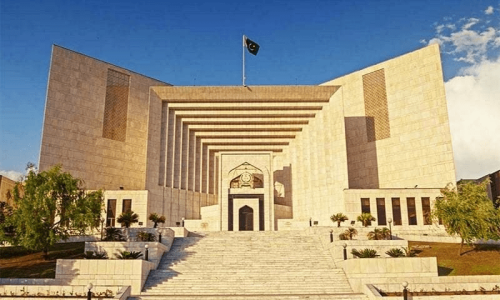
ISLAMABAD: The Supreme Court on Tuesday referred back a harassment complaint of a woman to President Arif Alvi, holding that the harassment law does not limit itself to sexual harassment alone, rather the real purpose behind it is to address gender-based discrimination at workplace.
“It includes a broad range of conduct and behaviour which results in workplace problems with serious consequences, one of the main being gender inequality,” Justice Ayesha A. Malik wrote in a judgement on a set of review petitions moved by Attorney General for Pakistan (AGP) office and Nadia Naz, who was appointed on a temporary basis as resource person (camera department) at the state-run Pakistan Television in 2007.
Justice Malik was a member of Justice Yahya Afridi-led bench that took up the petitions seeking review of the July 6, 2021 judgement of the apex court, which held that the Protection Against Harassment of Women at Workplace Act, 2010, (Pahwwa) was a “cosmetic legislation that blinkered in its application”.
Ms Naz was proceeded against departmentally, charge-sheeted, show-caused and consequently terminated from service on May 13, 2017 while her complaint was pending before the federal ombudsman for protection against harassment of women at the workplace, who later on Oct 16 also rejected it.
Law not confined to sexual offences, also encompasses gender discrimination at workplace, court rules
In the order, Justice Malik noted that both President Arif Alvi and the Islamabad High Court on Oct 11, 2019 decided the case of Ms Naz on the understanding that harassment meant sexual harassment having a sexual nature and form and did not examine the facts in the context of the injury caused.
The judge remanded back her complaint to the president to decide the representation against the order of federal ombudsman.
Justice Yahya Afridi, in his additional note, also concurred with Justice Malik’s finding to remand the representation of Ms Naz to the president for deciding it afresh. The representation would be deemed as pending before the president, and would be decided in accordance with the law, in view of the meaning and scope of ‘harassment’.
In her judgement, Justice Malik also pointed out error in the July 6 order due to the ‘interpretation’ of harassment. She observed that being an issue grounded in equal opportunity and equal treatment of men and women in matters of employment, sexual harassment in any form violates the dignity of a person as it was a demeaning practice that aims to reduce the dignity of an employee who has been forced to endure such conduct.
Sexual harassment as gender-based discrimination is gender-based hostility, which creates a hostile work environment, she noted. It is a reflection of the unequal power relations between men and women, translating into a form of abuse, exploitation and intimidation at the workplace which makes it a violation of a basic human right, she observed.
According to the court observations, the effect of the definitions of complainant and employee were not examined by the SC in the July 6 judgement, thus its interpretation of harassment, if taken at face value, makes the act redundant for men. Again, this goes against the object of the act that allows both men and women to bring a case against harassment at the workplace, Justice Malik noted.
Justice Malik observed the SC interference in its review jurisdiction was warranted and this review petition was maintainable, since the previous bench did not give the word sexual harassment its due deliberation and lacked the understanding of the scope of the law to reach proper conclusion.
Justice Afridi, in his additional note, noted that ‘harassment’ in form of ‘sexually demeaning attitudes’ was motivated to degrade and demean a person by exploitation, humiliation and hostility on the basis of his or her gender, and such harassment was rooted in gender-based discrimination.
‘Sexually demeaning attitude’ becomes harassment at the workplace, as it causes interference with work performance or creates an intimidating, hostile or offensive work environment for the victim of such attitude. If this important aspect of the matter had been considered, the SC decision would have been different, indicating an error apparent on the face of the record and providing a well-established ground to exercise review jurisdiction, Justice Afridi wrote.
Published in Dawn, June 7th, 2023