S. Korea’s lunar rover developer aims for first mission in 2032
SEOUL: South Korea’s consecutive successes with the homegrown Nuri rocket and lunar orbiter Danuri have led to the government’s ambitious road map to land on the moon in 2032 and on Mars in 2045. While the spotlight has been shining on rockets and satellites, less attention has been paid to the sector of space robotics.
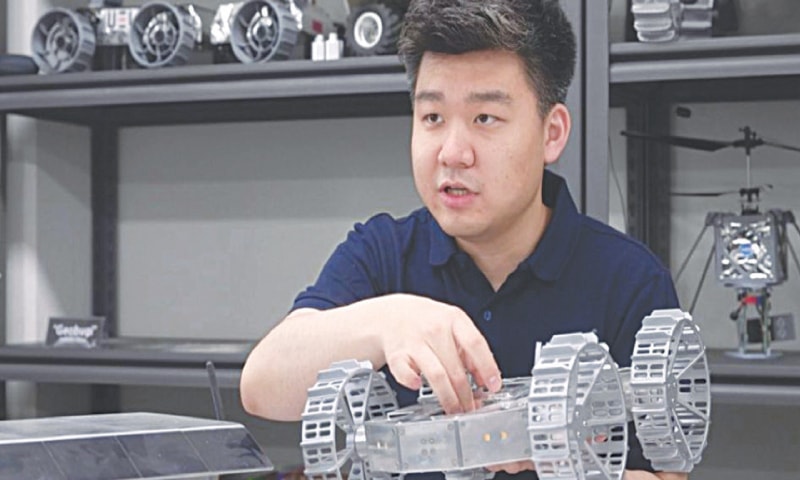
Unmanned Exploration Laboratory (UEL), a Korean startup led by a young CEO, is working relentlessly to develop lunar-roving vehicles as the country’s only player to make such a space robot.
“What we are focusing on at the moment is to develop a lunar rover that can go to the moon on the Korean rocket in 2032,” Cho Nam-suk, the 28-year-old CEO of UEL, told The Korea Herald.
He presented the three different classes of lunar rovers developed by UEL: Haetae, Scarab and Geobugi. Haetae is a mythical creature that can distinguish good and bad in Korean folklore. Geobugi means turtle in Korean.
The Haetae-class four-wheel rover was built to explore the terrain, conduct experiments, operate small-scale equipment and carry payloads with an external solar panel array to provide electricity.
The Scarab-class two-wheel rover equipped with sensors and a high-resolution camera was designed to explore terrains that are difficult to be reached with larger robotic systems.
The Geobugi-class four-wheel rover was developed with technology that can fold the rover’s camera mount and wheels to fit in small payload bays. The foldable rover has a lower risk of body damage during lift-off and landing sequences.
“We have conducted numerous tests with these rovers. They work well right now. But the level of operation is for experiments on the Earth. As we are trying to go to space, the design of the electronic boards inside the rovers has to change and all of their parts have to be swapped with ‘space-level’ parts,” said Cho.
Published in Dawn, May 31st, 2023