Former foreign minister Shah Mahmood Qureshi has said that while trade between Pakistan and India makes “economic sense”, it cannot be viewed in isolation.
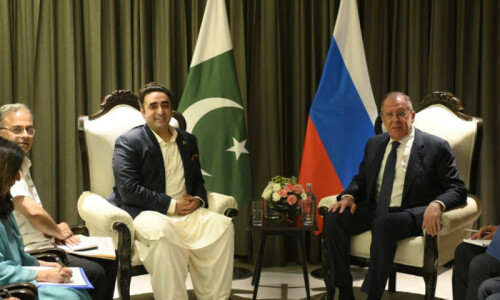
Qureshi made the remarks in an interview with Times of India published on Thursday. The PTI leader’s remarks come as his successor, Bilawal Bhutto-Zardari, is in Goa to attend a meeting of the Shanghai Cooperation Organisation Council of Foreign Ministers — the first visit to India by a Pakistani foreign minister in over a decade.
In the interview, Qureshi touched upon several aspects of Pak-India ties.
Asked about reports suggesting he was not keen on resuming trade with India, Qureshi said, “You see, the point is, I do see the benefits of trade between the two countries. It makes a lot of economic sense but it can’t be seen in isolation.
“It has to go in tandem with other things … but only trade [is] not enough. That’s all I’m saying. Trade can help improve relations, but trade in itself will not be enough.”
Commenting on Bilawal’s visit to Goa, the PTI leader made it clear that his party was not opposing the exercise and understood that this was a “multilateral obligation”.
“As a former foreign minister, who has been to such conclaves, this is an important visit. And by all means [he] should go ahead.”
At the same time, he said that it “might be useful” if there was a meeting on the sidelines to examine Pak-India ties.
“Our diplomatic relations were downgraded after the Pulwama incident and the Balakot misadventure,” he said, referring to when the Pakistan Air Force (PAF) had shot down two Indian planes that had violated Pakistani airspace in 2019.
“We have no trade and cultural ties at the moment and are looking for neutral venues for cricket matches. My party and I desire peace with India,” the ex-foreign minister said.
“How can we have good neighbourly relations and peace unless we have a dialogue? We need to recognise that we do have outstanding issues. We can’t wish them away. We have to address them,” he said, adding that the most civilised way of doing so was through dialogue.
“Doctrines like hot pursuit are mutually suicidal. In my view, we do not have a military solution to our issues, but they have to be resolved politically. They have to be resolved through dialogue.”
Qureshi went on to say that Bilawal had a “real opportunity” to raise issues that were relevant. “I hope he’s not shy of raising human rights issue[s], of raising the treatment minorities are getting, particularly Muslims. I hope he is not shy of raising the issue of water, which is becoming increasingly challenging between the two countries.”
He went on to say that while the SCO was a multilateral forum where bilateral issues cannot be raised, “what I’m saying is that on the sidelines … he should not miss that opportunity.”
At one point in the interview, when the interviewer alleged that the suicide bomber involved in the Pulwama attack in 2019 came from Pakistan, Qureshi noted that “Pakistan bashing” was very popular in India.
“That’s your point of view. There is a different point of view and that point of view is that it was a self-created, orchestrated incident for political reasons,” he said.
“I think India has to come out of this groove that we will not sit until and unless Pakistan gives up terrorism. Pakistan has fought terrorism, Pakistan is in the process of defeating extremism and terrorism. As I said, we have suffered. So let’s not pick that as an excuse and let things simmer.”
Qureshi was also asked about whether there were any backchannel talks during his stint as foreign minister.
“I don’t think there was a formal backchannel. But yes, as it happens, intelligence chiefs stay in touch.”
Held Kashmir
Asked whether there was an opportunity for Pakistan and India to discuss their issues as well as held Kashmir on the sidelines of the SCO meeting, Qureshi said, “Some steps taken by the BJP government on August 5, 2019 were unilateral and many Kashmiris within India are not happy with the situation.”
On August 5, 2019, India had revoked the special status of occupied Kashmir and stripped Kashmiris of the semi-autonomy they had for seven decades through a rushed presidential order.
“I know there are no quick fixes. I do understand it’s not going to be easy, but there can be some movement. The region needs peace and stability.”
Qureshi said that the abrogation of Article 370 was an “internationally recognised dispute” that cannot be brushed aside as India’s internal matter.
“Let’s call a spade a spade and recognise that there is an issue. By calling it an internal issue, I don’t think you’ll be able to resolve the issue.”