India arms Hindu militias to combat Kashmiri fighters
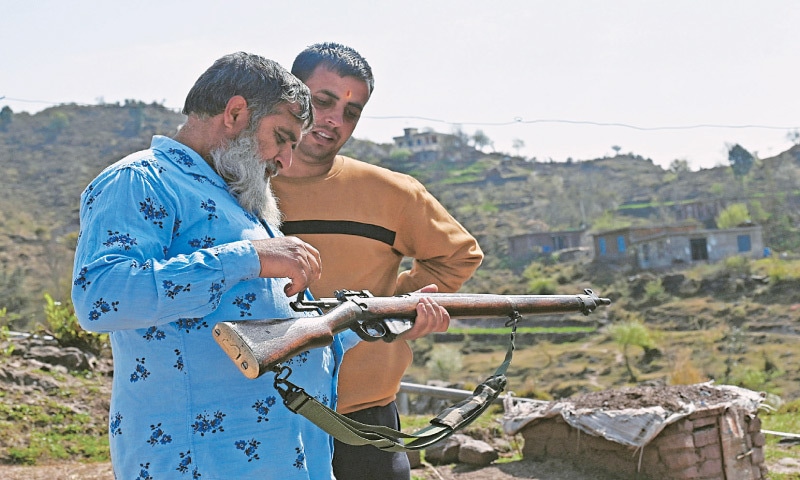

DHANGRI: Brandishing a bolt-action rifle, civil servant Sanjeet Kumar is one of 5,000 Kashmiri villagers who have joined all-Hindu militia units armed and trained by Indian forces to fight off attacks.
Delhi has more than half a million soldiers permanently stationed in parts of held Kashmir, as the Hindu nationalist government presses a bid to crush anti-India fighters.
Authorities announced the new militias last year, and a deadly assault in Kumar’s village in January prompted him to sign up. “We were totally terrorised by the attack,” the 32-year-old municipal worker in the electricity department said.
Wearing a saffron-coloured tilak on his forehead to mark himself as a member of the Hindu faithful, Kumar said he was ready and able to defend his home. “Anyone who turns a traitor to our nation is my target,” he added.
Villagers fear move will only exacerbate occupied territory’s woes
‘Only one community’
India has fought against the freedom groups demanding the Muslim-majority territory’s independence, or merger with Pakistan, in a fight that has claimed tens of thousands of lives.
The new militia units, known as Village Defence Guards, were unveiled last year in the wake of a string of murders targeting police officers and Hindu residents of India-held Kashmir.
The scheme has been broadly popular among the region’s Hindu residents, but Muslim villagers are concerned the militia will only exacerbate occupied Kashmir’s woes.
“My worry is about the way weapons are now being distributed among only one community,” said one elderly Muslim living in Dhangri, who asked not to be named. “Now weapons are being brandished around by young ones. This is not good for any one of us. I sense a growing tension,” he added.
Constant state of alert
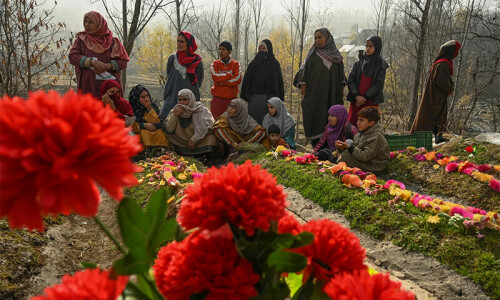
Many residents of Dhangri, the remote hamlet where Kumar lives, are still grief-stricken by the attack that claimed the lives of seven of their neighbours.
“With or without the weapons, we’re terrorised,” said farmer Murari Lal Sharma, 55, as he cradled his loaded 303 calibre rifle. “But now I will fight back.”
One Indian paramilitary officer said the newly armed villagers were on such a constant state of alert that his unit informed them beforehand of their night patrol, so that they were not accidentally mistaken for the Kashmiri fighters and fired upon.
“The purpose is to create a line of defence, not a line of attack,” Kanchan Gupta of India’s information ministry said.
India first created a civil militia force in held Kashmir in mid-1990s as a first line of defence when the armed resistance against Indian rule was at its peak.
About 25,000 men and women, including teenagers, were given weapons and organised into village defence committees in Jammu region.
Rights groups accused members of these committees of committing atrocities against civilians. At least 210 cases of murder, rape and extortion blamed on the militias were prosecuted, official records show — though less than two per cent of defendants were convicted.
Gupta said that these cases were individual acts and there was no record of organised crime by the militias. “There is always a chance that a few may turn rogue,” he said. “It’s not possible to control everyone.”
Most of the committees became dormant as Indian troops gradually throttled the resistance and the security situation improved.
‘Now there are guns’
This time around, militia members are warned by trainers from the paramilitary Central Reserve Police Force (CRPF) that they would be punished for misusing their rifles. “Alongside training them in firing, maintenance and cleaning of the weapons we also tell them what legal action will be taken for misuse,” CRPF spokesman Shivanandan Singh said.
Three people have nonetheless been killed since the new Village Defence Guards were established, including two who died by suicide using weapons issued to the militias. The wife of another member was killed in January when her husband’s rifle accidentally discharged.
But the reservations of some neighbours have not stopped men in the villages around Dhangri from clamouring to get their own arms. “Now there are guns in houses all around mine,” said Ajay Kumar, a flour miller and ex-serviceman, pointing out the homes of neighbours who had been given arms.
Published in Dawn, April 29th, 2023