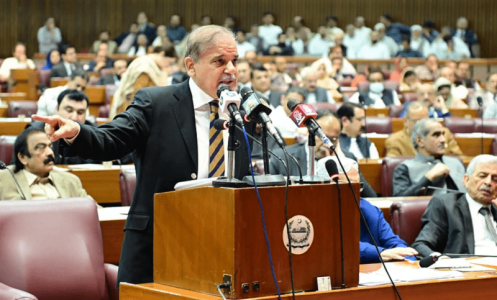
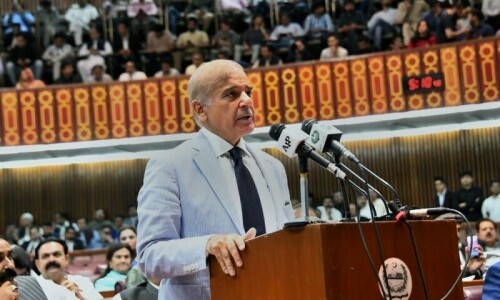
PRIME Minister Shehbaz Sharif’s surprise vote of confidence from the National Assembly on Thursday is part of a chain of events linked to the Supreme Court’s hearing of the elections delay case and the first meeting of PTI and PDM representatives in Parliament House to discuss polls.
Though the political atmosphere has been toxic over the last one year, these developments indicate that the country’s warring elite may be inching towards a negotiated solution to the prevailing constitutional and political crises.
The PM’s successful vote of confidence — though in a rump parliament shorn of any practical opposition — was designed to send a message to the apex court. Yet the question is: where to from here? Will the move help defuse the ticking time bomb? As the chief justice noted during Thursday’s hearing, the SC cannot force the government to hold negotiations with the opposition.
With the PDM-PTI meeting, facilitated by the Senate chairman, both sides have taken baby steps towards, hopefully, a democratic solution to one of Pakistan’s most protracted political crises.
Now it is up to the protagonists to find a way out of this morass so that the country can embark on the path to recovery. But as the events of the past year have shown, this will be far from easy, particularly when there are rigid elements within the PDM — such as the JUI-F as well as hardliners inside the PML-N — that want nothing to do with the PTI.
Still, with Mr Sharif securing the confidence of the Assembly, he needs to instruct his side to hammer out a deal with the PTI that can pave the way to polls.
The onus is on both sides to find a democratic solution to the impasse. If the PTI has shown some flexibility, the PDM should respond in kind. While the latter has said that parliament alone has the mandate to make laws and decide on elections, it should be kept in mind that no decision by the legislature should violate the Constitution.
Already the 90-day constitutional limit of the caretaker governments in KP and Punjab has passed, and it would not be incorrect to say that both interim administrations are operating in legal limbo.
Ideally, polls for both the National Assembly and the four provincial legislatures should be held on the same date, but the government should not insist that these be held in October or November after the current administration completes its term.
As this paper has previously argued, early polls nationally and in the provinces can offer a way out. If the political class fails to negotiate a settlement and powerful quarters move in to ‘save the day’ through extra-constitutional means, the politicians will have to answer to the people.
Published in Dawn, April 28th, 2023