Einstein’s risky Belgian stay after Hitler came to power
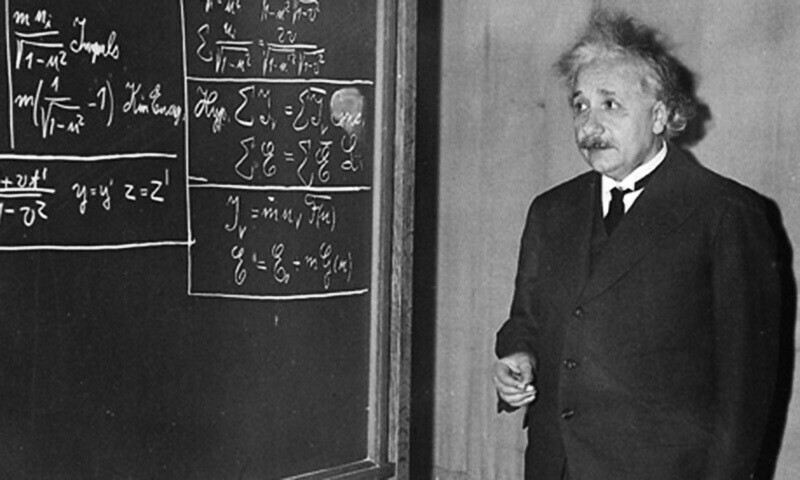
DE HAAN: Sitting alone on a bench, legs crossed, Albert Einstein enjoys the tranquillity of a public park in the Belgian coastal resort of De Haan.
His bronze statue attracts excited tourists to the town where the famous 1921 Nobel physics laureate sojourned 90 years ago, despite a Nazi secret society putting a price to his head. He never returned to Europe again.
It is a relatively unknown episode in the life of the American physicist of German Jewish origin, who was born in 1879 and died in 1955.
When Adolf Hitler came to power in early 1933, Einstein, a native of the southern German city of Ulm, was already teaching his theory of relativity in the United States.
Hitler’s Nazi Germany swiftly hunted Jews, targeting Einstein’s home near Berlin and confiscating his belongings.
On his return to Europe from across the Atlantic, Einstein landed in Belgium in March 1933 with Elsa, his second wife, fearful that returning to Germany would be too dangerous.
The physicist spent six months at De Haan under the careful watch of Belgian police.
“My mother knew Einstein well when she was young. Every morning, he walked on the promenade or on the beach,” said Brigitte Hochs, a 78-year-old Belgian guiding a team in the scientist’s footsteps.
The Hochs family ran the Bellevue Hotel for decades, with a building in the Belle Epoque style. The Einsteins rented one of them, the Villa Savoyarde.
Playing violin with a queen
Einstein would have a coffee on the hotel’s terrace after his walk in the fresh air. “It was his routine,” said Hochs. She said another famous Albert, the Belgian king Albert I whose wife was a Bavarian duchess, played a large role in Einstein’s short exile. “The king strongly advised Einstein not to return to Germany,” said Hochs.
Einstein knew the royal couple because he took part in congresses in Brussels. As well as the German language, he shared a love of the violin with queen Elisabeth. “They even played together,” Hochs added.
The physicist’s “Flemish” adventure inspired a comic last year by Belgian screenwriter Rudi Miel, who described the short exile as “a thriller”, noting that Einstein was under police watch because of “death threats”.
In the comic, “Le Coq-sur-Mer, 1933”, referring to De Haan’s French name Le Coq, Einstein, with his famously awry grey hair and thick moustache, appears as a hunted man in the drawings by Baudouin Deville.
The author imagines a blonde spy in a trench coat, pistol in hand, sent by the Nazis to kidnap Einstein as part of the Third Reich’s research on the atomic bomb.
Einstein’s discoveries on mass and energy from his famous equation E=mc2 laid the foundations for future nuclear fission, despite being him a pacifist all of his life.
‘A real jackpot’
In reality, there was never any kidnapping attempt while he was in Belgium. But the file devoted to him in the Belgian state archives shows the extent to which Einstein was threatened during his escapades on the shores of the North Sea.
“The file is a real jackpot. Through the surveillance reports, we discover professor Einstein’s personality,” said archivist Filip Strubbe.
Published in Dawn, April 28th, 2023