WHERE and, perhaps more importantly, when does it end? It had been hoped that the judiciary would keep a level head while others all around them were losing theirs.
However, it seems that even the wisest among us cannot help but succumb to the afflictions of the body politic. The unseemly drama that has played out in the highest court of the land this week seems to have drained the Pakistani people of whatever residual hope they had of seeing sanity restored to the country anytime soon.
One continues to hope, however, that the differences between the esteemed judges are purely academic and philosophical and not, as some would have us believe, over any personal resentments. The nation has seen enough bile spewed in the political arena to have the stomach for another ugly schism.
Never before has the top court appeared this polarised, not even when it was meekly stamping its approval on the treasonous acts of dictators past. Is this really the hoped-for dawn of judicial independence? Right now, it is very difficult to tell.
Meanwhile, the credibility and integrity of the court continue to be undermined on a daily basis as politicians and political camps openly declare favourites. It is obvious that ordinary people can no longer decide whom to trust. Perhaps this was bound to happen.
The ‘great unravelling’ triggered by the dismantling of the PTI regime last April was perhaps bound to unravel the country’s top court as well.
After all, the PTI had climbed to power on the back of several judgements that cut the feet out from under its political opposition. Yet, to think that the Supreme Court and its workings would be seen as crudely politicised in a bid to ‘even the scales’ could not have been anticipated.
A fundamental question of overriding public interest continues to remain unanswered: if the Constitution has prescribed elections to dissolved assemblies within 90 days, why are they not being held? The Supreme Court ought to have spoken as one voice on the matter.
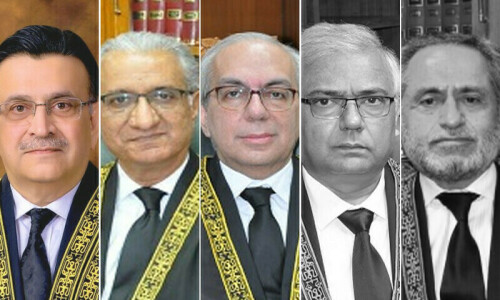
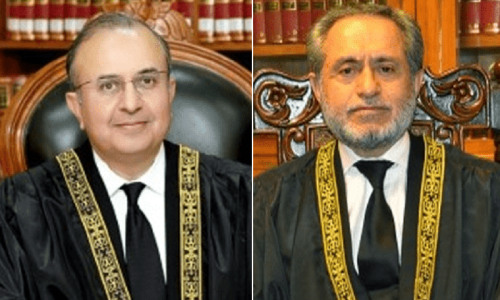
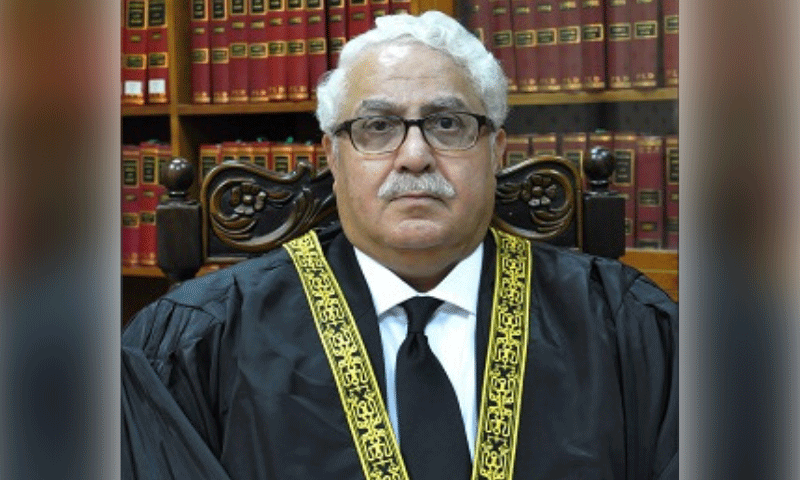
Instead, Chief Justice Umar Ata Bandial appears reluctant to form a full-court bench, and matters are now coming to a head. The subsequent commentary from interested quarters has given the divisions within the Supreme Court a political colour. This is bad not just for the sitting chief justice, but also for the incoming one.
The country cannot afford any of its top judges to be seen to be associated with one political narrative or the other. It bears repeating that they must immediately resolve their differences amongst themselves in order to present a united front to the other branches of the state. An openly divided judiciary cannot serve as a check on the executive and legislature in any meaningful way.
Published in Dawn, April 1st, 2023