0
0

KARACHI: Amid fears of default, growing political instability and a deepening crisis of governance, leaders from the ruling coalition and other senior politicians agreed on Sunday that it was high time for the major political parties — those who are in power and the opposition Pakistan Tehreek-i-Insaf — to find a way out of these challenges through dialogue.
Otherwise, the country would face an irreparable loss the like of which “one couldn’t even imagine”.
Dubbing the current political leadership ‘incapable’, the parliamentary system ‘ineffective’ and the economy ‘on the verge of collapse’, politicians from different backgrounds appealed to the Chief of Army Staff and the Chief Justice of Pakistan to keep their institutions within the defined boundaries of the Constitution.
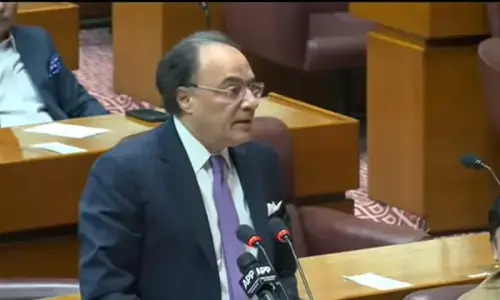
The strong warning, thoughts about reformation, and a call for dialogue came from a host of political mavericks like former prime minister and PML-N leader Shahid Khaqan Abbasi, his party colleague and ex-finance minister Miftah Ismail, and Senator Mustafa Nawaz Khokhar, who parted ways with the PPP recently, at a day-long seminar on “Reimagining Pakistan” at Habib University.
They said “ours is an apolitical platform for political awakening among parties” so they could focus on their real agenda of reforms, stability and consensus on key national issues.
“It’s [the crisis being faced by Pakistan] a test for everyone,” said Mr Abbasi in his address. “Whether it’s Shehbaz Sharif, Imran Khan, Fazlur Rehman or Asif Ali Zardari – it’s also your test. It’s almost proven that the crisis facing Pakistan cannot be solved by any party alone. “So the country’s leadership needs to think beyond personal agendas. They have to sit together. They have to find a way out. The people of Pakistan and the youth of Pakistan are looking up to you.
Even if you don’t have any solution, still you can try.”
He wondered how the federal cabinet was “working as usual” at a time when Pakistan was facing the worst challenges of its existence. This had exposed the capability of the governing system and betrayed the indifference of the ruling class to the misery of the poor.
“This country needs a new social contract,” said the former premier.
“And when we talk about a new social contract, it’s in fact implementation of our Constitution in its true spirit. When will we be able to send true representatives of the nation to parliament?
“Let me be very clear. This parliament is not doing legislation for you and the people of Pakistan. It is doing legislation only to facilitate the sitting government. The cabinet doesn’t make decisions for the majority. There are some other standards which are followed for such decisions.”
He said it was regrettable that a majority of legislators in a country facing default were tax evaders, but they were supposed to make laws for tax reforms, revenue generation and uplift of the poor.
“Is it justified that a man who doesn’t pay taxes is empowered to tax others and make laws for that purpose?” he questioned to a burst of applause from the packed auditorium.
Mustafa Nawaz Khokhar, a former PPP senator, explained the objectives of the platform and the idea behind its birth. He said the seminar would dwell at length on those issues which must be discussed by parliament and the political leadership.
“But unfortunately, our political leadership has decided not to raise issues which make people aware about their rights,” he said. “Our political dialogue and discussion revolve around blame game. After more than 75 years and losing half of the country, we have not learnt anything and this makes me very pessimistic.
‘Reconstruction of religious thought’ “I feel disappointed and don’t see any hope.”
He said growing religious extremism had damaged the scope of dialogue and allowed elements with vested interests to exploit any situation in the name of religion.
“We need reconstruction of religious thought,” said Mr Khokhar. “Allama Iqbal addressed this during the 1930s in his major philosophical work. Why can’t we do it now?
“Different interpretations of religion in our society by different segments have caused us irreparable loss. It has caused hatred and made us fight each other. This needs to be fixed.”
Former finance minister Miftah Ismail, who moderated the event, made brief addresses to the audience, accusing the Sindh government of trying to stop the seminar in Karachi.
“We originally planned to hold this seminar at IBA, but we came to know that the Sindh government has made it clear IBA won’t hold such events,” he said.
“Then we opted for the Arts Council. But the authorities there too showed reluctance to host the event, presumably on a phone call or two.
“So finally we requested the Habib University, which was generous enough to give us space. So I think many people disapprove of our move to raise a voice of dissent.”
Published in Dawn, March 13th, 2023