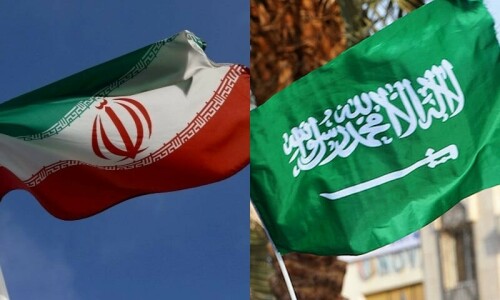
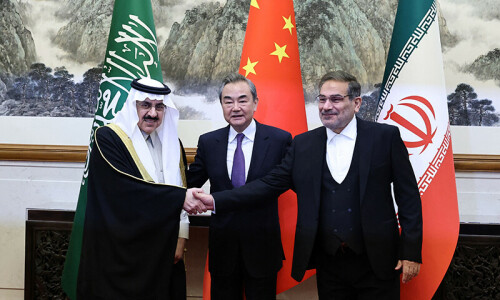
THE Chinese capital is not usually associated with Middle East peacemaking. Yet it was in Beijing on Friday that smiling top officials from the host country, Saudi Arabia and Iran announced to a surprised world that Riyadh and Tehran had decided to re-establish diplomatic relations.
This is no mean achievement, considering the terse ties between the two states, particularly in the decades since 1979’s Islamic Revolution in Iran. The deal, if all goes according to plan, would open up a new vista of cooperation between two of the Muslim world’s most influential states, while the breakthrough also brings to the fore a dominant China’s newfound role as international peacemaker.
Relations have alternated between lukewarm ties and open hostility between Saudi Arabia and Iran ever since the revolution. However, the relationship suffered a severe jolt when Riyadh executed prominent Saudi Shia cleric Sheikh Baqir al-Nimr in 2016. Thereafter, Iranian protesters attacked Saudi missions in Tehran and Mashhad, which led to the rupture in diplomatic ties. During and before this period, both sides have competed for influence in Lebanon, Bahrain, Iraq and most notably Yemen, where the devastating civil war has pitted the pro-Iran Houthi militia against the Saudi-allied government. Therefore, a Saudi-Iranian détente has the potential to bring stability to all these states, particularly Yemen.
Moreover, improved ties between what are seen as the Muslim world’s leading Sunni and Shia powers can also mean better intra-Muslim relations. This is especially true for countries like Pakistan, which have witnessed significant sectarian violence, much of it influenced by the Saudi-Iran rivalry.
Coming to China’s role, the peace deal signals that Beijing is willing to take a more active role in international diplomacy. This may be partly due to the fact that China wants stability in an important market — the Gulf — and maintains good relations with both Riyadh and Tehran. Iraq and Oman have also played quiet, important roles in bringing both sides to the table.
However, the deal has sent alarm bells ringing in important capitals, most significantly Washington. The US has welcomed the move, albeit in a cagey manner. The American establishment seems to be wary of Iran breaking out of isolation — that the US has worked quite hard to maintain — and is also not too happy to see China playing an active role in global diplomacy. Meanwhile, in Tel Aviv, there is disquiet bordering on panic, as senior opposition figures have termed the peace deal a “failure of Israel’s foreign policy”.
The path to peace for the Saudis and Iranians will not be easy, as there remains a wide gulf of mistrust while there are spoilers aplenty who will be seeking to sabotage the deal. But for the sake of their people and the Muslim world, both sides need to make it work.
Published in Dawn, March 12th, 2023