Bengalis were in majority, but Bangla was not made national language: Dr Ishtiaq Ahmed

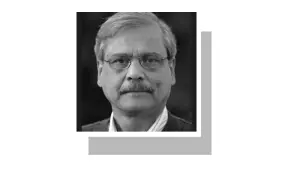
KARACHI: Professor Emeritus of the University of Stockholm Dr Ishtiaq Ahmed has said if a country is established on the basis of religion it will remain de facto.
During his keynote address at the opening session of the two-day Global Conference on Research in Education and Social Sciences that commenced at Szabist here on Friday, Dr Ahmed spoke about the territorial way of nationalism, fascisms and social hierarchy, colonialism and feudalism and the right of voting and contesting for public office and the agitations and struggles in the beginning of the 20th Century giving way to revolutionary changes in society.
Speaking about the partition of India, he said that if a country was established on the base of religion it would remain de facto.
He said: “The partition of India was based on the two-nation theory. Ideas about majority nurtured on both sides although Congress recognising plurality in India at first only wanted freedom from British rule. But the Muslim League spoke about a separate homeland for Muslims.
“Then after Pakistan came into existence there were Bengalis who were 55 per cent and in majority, but the government made Urdu the national language instead of making both Bangla and Urdu national languages. As a result, the Bengalis felt alienated and so the problem of majority persisted,” he pointed out.
Dr Ishtiaq Ahmed speaks about Partition, nationalism at Szabist conference
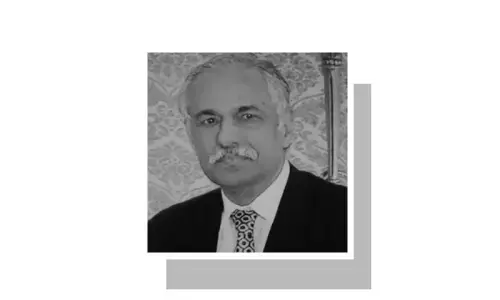
Talking about different way of thinking, physicist and scholar Prof Dr Pervaiz Hoodbhoy reminded: “Galileo said that the planets revolved around the sun for which he was sentenced to death by the Roman Church. Though he managed to survive by apologising, another way of thinking emerged.”
“I am a natural physicist,” said Dr Hoodbhoy. “Some principals that underline natural science also underline social science. The methods are similar in every field of science. You need logic, experience and evidence,” he said.
“Science developed relationship in cause and effect. Not everything is divine intervention as some like to think. Science has given us a way of understanding the universe. The universe runs on the laws of science which again brings us to cause and effect,” he said.
Architect and town planner Arif Hasan, meanwhile, spoke on seeing change in Karachi over the years. “I have seen this change taking place during my work and research,” he said.
Speaking about his work as the principal consultant on the Orangi Pilot Project, he said that Orangi was an entirely working class settlement in 1981. People there would refer to us using titles such as janab, mohtaram, huzoor, etc. “Young men there now no longer have the same vocabulary. They refer to you by calling you Bhai, Baji, Uncle, Aunty, etc.”
“There weren’t any working women in Orangi in 1981. At the most, there would be a few home-based women workers but today you see Suzuki loads of women workers going to work to garment factories or pharmaceutical factories. Many women have also received education and have white collar jobs or are teachers or entrepreneurs,” he said, going on to also discussing changes he had seen over the years in rural Sindh.
He also spoke about seeing more female students than males in universities, couples going for more court marriages, etc.
“All this has changed your society and you are not talking about it and not researching it. There is a big gap in your understanding of society as a result,” he concluded.
Earlier, Szabist President Shahnaz Wazir Ali also spoke about the value of research in Pakistani universities.
Szabist Vice President (Academics) Prof Dr Mohammed Altaf Mukati delivered the vote of thanks.
Published in Dawn, March 11th, 2023