While the chief justice of Pakistan solely enjoys the discretionary powers to take suo motu, constitute the benches and fix the cases purely ‘under the Constitution’, members of the legal fraternity and civil society believe that these need to be revisited and structured by framing proper rules on ‘moral grounds’.
Ahmed Bilal Mehboob, who heads the Pakistan Institute of Legislative Development and Transparency (Pildat), told Dawn that because the chief justice enjoys ‘complete powers’ under the law to constitute a bench for hearing any case, he can reconstitute the bench by including or excluding any judge at will.
“I don’t think anyone can say that this is illegal or unconstitutional. Nothing illegal has happened,” he told the Dawn in the context of Tuesday’s developments in Justice Qazi Faez Isa’s court.
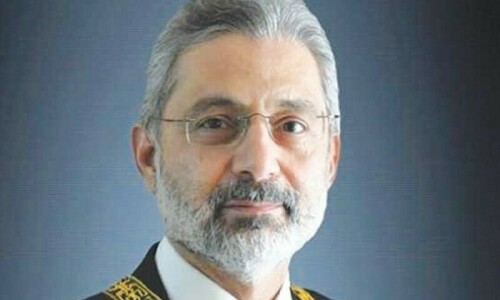
On Tuesday, Justice Yahya Afridi and Justice Isa refused to take up cases that were placed before them after the roster was changed and a new bench was constituted.
When the SC registrar was asked to explain the reason for the change, he maintained that it was done at the instructions of the CJP.
Experts say while CJP is within his rights to reconstitute benches as he sees fit, the process needs to be more structured
Talking about the Supreme Court’s rules that delegate such powers to the CJP, he said: “It can be said that this rule is not good [since] it was not equitable and does not do justice, as there should be some criteria as to which judge would be included or not [in a bench],” he added.
Speaking about the political and moral effects of such practices, the Pildat chief was of the view that the people would not like it, and it would ultimately lower the respect for the institution in the eyes of the people.
There is already a division prevalent in society about the decisions of the judiciary at the moment, he noted, which should have rather been overcome. But this practice would further widen such a gulf, he opined.
He said everyone was objecting to the inclusion of junior judges in lieu of senior judges in the SC bench hearing the elections’ case, so there should be some criteria for this.
“For example, senior puisne judge Qazi Faiz Isa was not made part of the bench hearing such sensitive cases, which was very unfortunate.”
Use of technology?
Barrister Salahuddin Ahmed, a former president of the Sindh High Court Bar Association, said it was high time that the CJP’s discretionary powers to constitute benches and fix cases should be structured and proper rules be framed in this regard so that constituting the benches and fixing the cases should not be arbitrary.
Barrister Ahmed, who has in the past petitioned the Supreme Court over the issue of the elevation of junior judges from the high courts, suggested that it would be better to use technology for the constitution of benches by using a computer algorithm or something similar.
This kind of a system — where taking suo motu, constituting benches and fixing the cases is at the absolute discretion of the chief justice — breeds distrust and creates divisions between the Supreme Court, he said.
Importance of suo motu powers
However, Faheem Siddiqui, a former judge of the Sindh High Court, defended the discretionary powers enjoyed by the country’s top judge.
He argued that the Supreme Court’s rules have delegated powers to the chief justice of Pakistan to constitute or reconstitute benches, or take other administrative decisions.
Mr Siddiqui, a career judge who served in the district judiciary before his elevation to the SHC, told Dawn that the mechanism of the exercise of discretionary powers by the CJP could only be changed either by amending the apex court’s rules or through an act of parliament.
As far as the powers of suo motu were concerned, this was a constitutional matter, he said. “If such powers are to be withdrawn, then there would have to be made an amendment to the Constitution.”
The former justice was of the view that curtailing the suo motu powers of the Chief Justice of Pakistan would not be an appropriate act, because in some cases this proves to be very important, since suo motu notices invariably relate to questions of fundamental rights.
Regretting the fact that the judiciary had to exercise this power in the matter of elections to the Punjab and Khyber Pakhtunkhwa assemblies, Mr Siddiqui said that this was, “in fact, a failure of the politicians.”
“In the current situation, suo motu powers are being exercised because fundamental rights are being violated and the judges of the superior judiciary have taken an oath to protect fundamental rights.”
Mr Siddiqui further argued that if any parliamentary attempt was made to curtail the powers of the CJP in this regard, it would be subject to judicial review by the court. In such a situation, the final opinion that would prevail would ultimately be that of the judiciary, which could open another Pandora’s box, he concluded.
Published in Dawn, March 1st, 2023