ISLAMABAD: Energy Minister Khurram Dastgir Khan on Monday told the parliament that the government would recover Rs9.90 to Rs14.24 per unit outstanding fuel costs from consumers of less than 300 units in an 8-month staggered schedule.
Mr Dastgir said an additional surcharge of Rs3.82 per unit would also be imposed on those using above 300 units to fund power sector loans under the insistence of the International Monetary Fund (IMF).
Testifying before the National Assembly’s Standing Committee on Power, Mr Dastgir said the government had to satisfy the IMF on each and everything of the power sector after discussing all the facts and figures as the fund wanted an immediate increase in electricity rates to reach an agreement for an economic bailout.
The meeting of the panel was presided over by MNA Sardar Riaz Mehmood Khan Mazari.
In addition to this substantial fund-raising from the consumers, the Power Division has also sought about Rs300 billion in next year’s budget for development projects to overcome system challenges like theft control and technical loss reduction.
Power minister says immediate tariff hike needed for IMF deal
The power minister said the pending dues on account of fuel cost adjustments of June and July last year, postponed due to floods, would be recovered while a financing cost surcharge would be imposed on consumers with over 300 units to finance debt parked against power holding company.
It may be noted that the Power Division has already asked the National Electric Power Regulatory Authority (Nepra) to issue a new tariff schedule so that Rs10.34 per unit on protected consumer category of up to 200 units and Rs14.24 per unit on non-protected consumers of up to 300 units over eight months – starting from March to October 2023 – at a rate ranging between Rs2.75 to Rs1.50 per month.
The regulator is expected to complete formalities in the first week of March. These charges stood recovered from bigger consumers of 300 units and above per month but were postponed for others due to floods.
Separately, the government has also committed to the IMF to finance over Rs800bn worth of power sector debt through the imposition of Rs3.82 per unit financing cost surcharge.
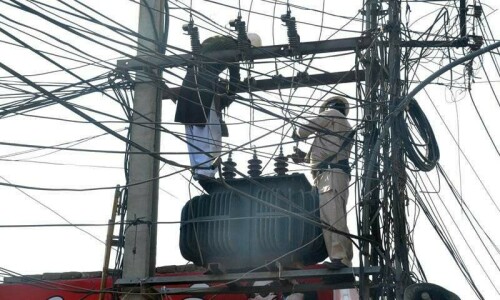
The minister said the government was now working on a strategy to contain fuel costs by producing maximum electricity from solar energy in the daytime to minimise production from expensive imported fuel oils. Also, Mr Dastgir said the government was not going for privatisation of distribution companies and would instead outsource loss-making feeders for recovery. He said the loss reduction and theft control would have to be dealt with because theft control was one of the most important factors for tariff reduction as such factors contribute to a rate hike.
He told the panel that there were feeders where 98pc bills could not be recovered and the committee could be given an in-camera briefing on billing and theft of such areas.
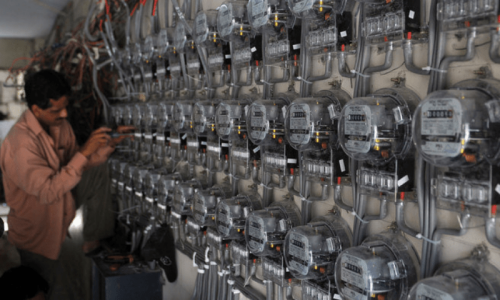
He said the technology would also play an important role in this regard and large consumers would be shifted to smart advanced meters by June this year that would help real-time live monitoring of about 150,000 large consumers.
The panel asked the Power Division to work out a mechanism to bring load-shedding at the micro level instead of shutting down entire feeders. It also asked the Power Division to submit a draft of changes to be brought into the Electricity Act 1910 to avert damages caused due to high-tension transmission lines passing over inhabited areas.
The panel cleared the Rs298.44bn Public Sector Development Programme (PSDP) proposals of the Power Division for 2023-24.
Published in Dawn, February 28th, 2023