WASHINGTON: Pakistan has not crossed the tipping point and it’s still possible to rebuild the national economy with competence and courage, the country’s former finance minister and a senior Pakistani American economist said on Wednesday.
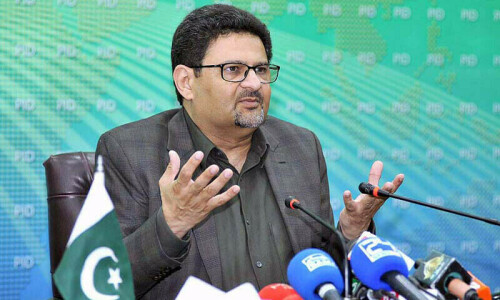
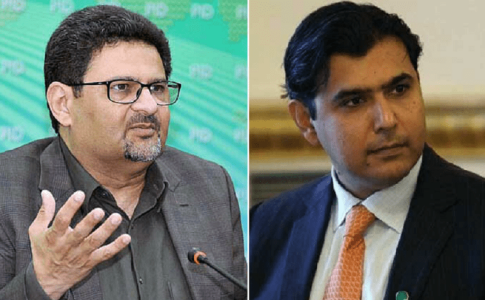
Former finance minister Miftah Ismail and Atif Mian, a professor of economics, public policy, and finance at Princeton University, expressed these views at a webinar arranged by the Centre for Middle East Policy at Brookings Institution, Washington. The discussion focused on the roots of Pakistan’s economic challenges and the future of its economy.
The organisers pointed out that 2022 saw political turmoil, an economic crisis, and catastrophic flooding in Pakistan. They noted that backbreaking inflation, depreciating currency, and precariously low foreign reserves had further complicated the situation.
They invited the discussants to talk about “the long-term roots of these problems, how political instability shapes them, and what economic policy Pakistan should adopt to address its difficulties.”
The moderator, Madiha Afzal, shared a question that she said she had received from many viewers: Has Pakistan crossed the tipping point? Is it too late to revive the economy?
“I think, absolutely we can come back from the brink. First, the next six, seven, eight months are going to be very difficult. The inflation is going to be fairly high,” said Mr Ismail while responding to the questions.
But he warned that the inflation could be much higher if Pakistan didn’t go back to the IMF programme. “We have to understand that at this point, doing the IMF programme, staying on track” were the right things to do, he added.
“We will, probably, have back-to-back IMF programmes because we will not have enough (foreign exchange) reserves come June. So, we cannot survive without an IMF programme,” he said.
Pakistan, he said, would have to “stay with the IMF tutelage or policy paradigm,” and then it could start talking about reforms, like population planning and education, to come out of the quagmire it’s sinking into.
He also suggested reforming the power sector which, he said, was “a big drag on the national economy,” improving the gas distribution system and providing more funds to the Benazir Income Support and income transfer programmes. He pointed out that Pakistan was currently spending less than half per cent of its GDP on such programmes, which needs to be increased to one or one-and-a-half per cent of GDP.
This would help improve education and reduce poverty and will also help eradicate stunting and malnutrition.
Pakistan, he said, needs to grow by 8-9pc a year for 20 years to create a substantial middle class. “And we can quadruple our income in those years.”
“It is never too late. That’s just negative thinking, the positive thing is, it’s amazing how small Pakistan’s problems are,” said Prof Atif Mian, endorsing the former finance minister’s optimistic views. “I will give you an example, what’s the price of a cheap burger in the US, $10? If we could only raise Pakistan’s productivity, so every citizen of Pakistan can just sell one burger to the rest of the world in a year, that’s like $2bn. You just sell a few burgers, and you can solve all the problems that we are talking about today,” he said.
“This is how small; we are talking peanuts here for the country. This is the good news as well as the depressing news. That for peanuts we have made 220 million people suffer like the way they are suffering today.” Prof Mian said that Pakistan needed two Cs — competence and courage — to overcome its problems.
“Competence, because you need to figure out what to do. You need courage because you are talking about changing the way things have been done before,” he said. “But if you do that, people will get angry. Those who have made all their money in land and real estate, will not like it when you say “let’s sell burgers to the rest of the world.”
Once that’s done, things could change very quickly and in 20 years, it will be a wholly different story, he said.
Prof Mian, who is an expert on development economics, said that the despondency that the nation suffered from could be removed within an electoral cycle.
“I believe that if a government comes in with these things, within their tenure they can turn things around. In the sense that there will be hope going forward,” he said.
Published in Dawn, February 2nd, 2023