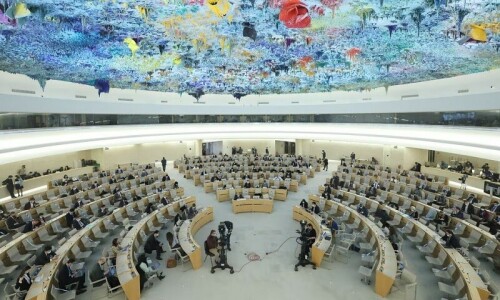
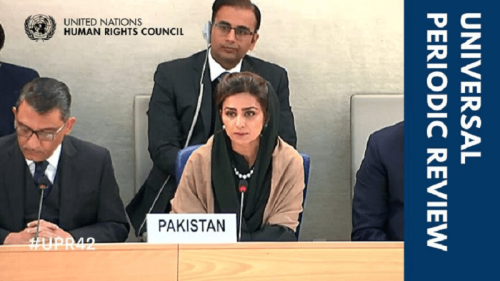
ISLAMABAD: Pakistan has received 340 recommendations from UN member states on its fourth periodic report on the human rights situation in the country, and the government will examine these recommendations and report back to the UN Human Rights Council (HRC) in its forthcoming meeting.
A draft report prepared on Wednesday by the Working Group on Universal Periodic Review (UPR) of the Geneva-based Human Rights Council, available with Dawn, stated: “All conclusions and/or recommendations contained in the present report reflect the position of the submitting state(s) and/or the state under review. They should not be construed as endorsed by the Working Group as a whole.”
Pakistan’s response to the recommendations will be included in the outcome report adopted by the HRC at its 53rd session, it added.
The HRC selected Argentina, Gambia and Nepal as the group of rapporteurs (troika) to facilitate the review of Pakistan.
UN member states complete review of Islamabad’s fourth periodic report on human rights
A list of questions prepared in advance by Angola, Belgium, Germany, Liechtenstein, Panama, Portugal — on behalf of Group of Friends on national mechanisms for implementation, reporting and follow-up — Slovenia, Spain, Sweden, the United Kingdom and Northern Ireland and the United States was transmitted to Pakistan through the troika.
During the interactive dialogue, 122 delegations made statements. Canada proposed to develop a strong policy and delivery mechanism to ensure the registration of women voters, and protect women voters from violence and disenfranchisement as they cast their ballots.
Several countries demanded ratification of the International Convention for the Protection of All Persons from Enforced Disappearance and incorporate it into domestic law.
Luxembourg proposed placement of moratorium on death penalty and ratification of the Second Optional Protocol to the International Covenant on Civil and Political Rights aimed at abolition of the death penalty.
Poland called for fully respecting freedom of religion or belief in accordance with the international human rights law, in particular by: reforming blasphemy laws, especially as regards the existing legal possibility of punishing blasphemers by death, which creates a climate conducive to extrajudicial killings; repealing other legal provisions discriminating against members belonging to religious minorities; halting abductions, forced marriages and forced conversions of women and girls from religious minorities.
The US demanded repealing or amending blasphemy laws, and ending other discriminatory laws used against members of Ahmadi and other religious minority communities.
Australia demanded upholding freedom of expression, including by amending the Protection of Journalists and Media Professionals Act, to avoid unnecessary restrictions on journalists and protect their safety and welfare.
Published in Dawn, February 2nd, 2023