0
0

WASHINGTON: The United States has once again shied away from pushing for a meaningful dialogue between India and Pakistan, saying instead that only these two neighbors can decide the pace, scope, and character of their talks.
A Monday afternoon news briefing at the US State Department showed how delicate it’s to offer comments on any development in this sensitive region, whether it concerns the need for resuming India-Pakistan talks or a BBC documentary.
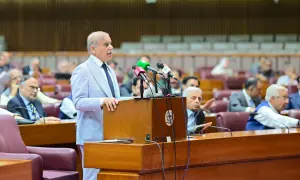
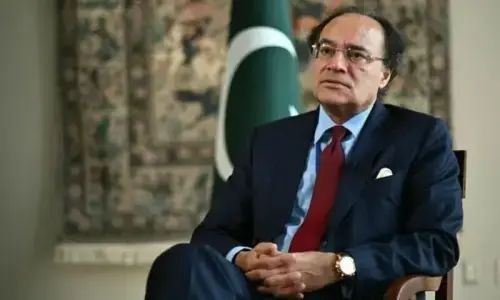
“We have long called for regional stability in South Asia, but the pace, the scope, the character of any dialogue between India and Pakistan is a matter for those two countries, India, and Pakistan,” said the department’s spokesperson Ned Price when asked to comment on Prime Minister Shehbaz Sharif’s latest offer for resumption of talks with New Delhi. Last week, the prime minister asked his Indian counterpart Narendra Modi to hold serious and sincere
talks to resolve burning issues, including Kashmir, and said the United Arab Emirates could play an important role in bringing India and Pakistan to the table.
Ned Price says it is up to both nations to decide how they want to engage with each other
But a day later, Mr Sharif’s office clarified that talks with India can only take place after the country reverses its “illegal action of August 5, 2019”, which seeks to illegally alter the demography of the Muslim-majority state of Indian occupied Kashmir.
Asked to comment on the prime minister’s offer, Mr Price said: “We have long called for regional stability in South Asia. That’s certainly what we want to see. We want to see it advanced.”
The US official also talked about Washington’s relationships with both New Delhi and Islamabad. “These are relationships that stand on their own. We do not see these relationships as zero-sum. They stand on their own,” he said.
While in an earlier briefing, Mr Price emphasised the “importance of maintaining these valuable partnerships” and said Washington “would like to see constructive dialogue between India and Pakistan”, but on Monday, he left it for India and Pakistan to decide how they want to engage with each other, instead of reiterating the offer to help them negotiate.
Mr Price was even more careful while replying to another question about a recent BBC documentary on Mr Modi that underlined his role in the 2002 Gujrat massacre.
“I am not aware of this documentary that you point to, but what I will say broadly is that there are a number of elements that undergird the global strategic partnership that we have with our Indian partners,” he said.
Instead of addressing Mr Modi’s role in the massacre, the US official noted that the United States and India have close political and economic ties, and “exceptionally deep people-to-people ties” and shared “values that are common to American democracy and to Indian democracy.”
He noted that India is “the world’s largest (and) a vibrant democracy” and both sides were keen to “reinforce all of those elements that tie us together.”
Responding to a question about press freedom in Pakistan, Mr. Price said: “Free press and informed citizenry are key for any nation and its democratic identity, its democratic future, the democratic aspirations of its own people.”
But he also said that he would not comment on any specific case as those questions should be addressed to the government of Pakistan.
The US official, however, minced no words in condemning the recent burning of a copy of the holy Quran in Sweden, saying: “I’m certainly not refraining from condemning this particular action. It’s repugnant. It … is vile.”
Mr Price pointed out that a similar incident happened in the United States as well that was “equally repugnant and vile, and that we spoke out against at the time just as we’re doing so in the context of what has happened in Sweden.”
Published in Dawn, January 25th, 2023