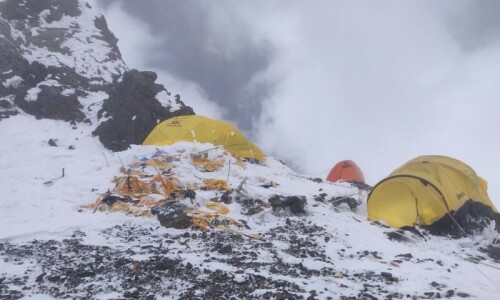
GILGIT: Mounting political uncertainty and visa delays poured frigid water on foreign adventurers’ plans to visit Gilgit-Baltistan this winter and attempt to scale some of the world’s highest mountains, and not a single foreign mountain expedition has arrived this season.
High permit fees and the United States, Australia and Saudi Arabia cautioning their citizens against travelling to Pakistan also added insult to injury.
According to the GB tourism department, no foreign expedition or trekking group has been issued a permit this winter expedition season, which usually lasts from November to February. And the fact the season is set to end after a little over a month, no adventure group is expected as they usually need at least two months to prepare for expeditions.
Only two foreign expedition groups applied for a visa to summit Nanga Parbat this winter, but visa delays compelled them to cancel their plans.
This stands in stark contrast to previous years when hundreds of foreign mountaineers visited Pakistan in winter to attempt to summit the mighty mountains like K2 and Nanga Parbat.
Besides, last summer was the first time when more than 1,600 international climbers visited GB.
Karar Haidri, secretary to the Alpine Club of Pakistan, told Dawn that prevailing political uncertainty in the country was the main factor behind the decline, as many adventure tourists cancelled their visits to the region.
However, Asghar Ali Porik, a tour operator from GB, told Dawn the visa policy was main cause, as it resulted in delayed issuance of visas.
“There is no time frame to the issuance of visa to trekkers and mountaineers once they have applied. Foreign adventure tourists couldn’t manage their plans accordingly,” he said.
Another factor was a 40 per cent hike in permit royalty fees from this year, said Mr Porik, who organised many foreign expedition groups at K2 and other mountains last winter.
When contacted, an official of the GB tourism department agreed that the decline in the number of adventurers visiting Pakistan was caused by political unrest and the visa regime.
Five of the world’s 14 eight-thousanders — mountains above 8,000 metres from sea level — are in Pakistan, including the world’s second-highest peak K2 (8,611 metres), followed by Nanga Parbat (ranked ninth at 8,126 metres), Gasherbrum-I (11th at 8,080 metres), Broad Peak (12th at 8,051 metres), and Gasherbrum-II (13th at 8,035 metres).
Naiknam Karim, chief executive officer at Adventure Tours Pakistan, lamented that top climbers from across the world had applied for a visa to attempt the summit of Nanga Parbat this winter, but they cancelled their plans after visa delays and instead went to Nepal.
He said that complications in the visa application process and delays, which could last for months, also prevented other adventurers from even applying.
The tour operators and other stakeholders demanded that the government relax the visa policy for foreign adventurers and there should be one tourism policy in the country.
Published in Dawn, January 23th, 2023