ISLAMABAD: The changes to the National Accountability Ordinance (NAO) have not “abridged” the fundamentals of the Constitution or eroded the “concept of public trust and accountability”, said Makhdoom Ali Khan, counsel representing the federal government in a petition against NAB amendments.
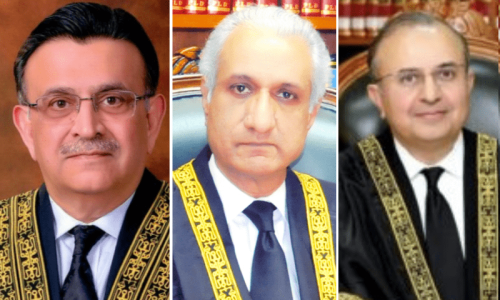
The counsel was arguing before a three-judge bench headed by Chief Justice Umar Ata Bandial that had taken up challenges to the Aug 2022 amendments to the NAB law by former prime minister Imran Khan.
Makhdoom Ali Khan emphasised that when the parliament legislates a law to be applied with retrospective effect then it also reserves the right to repeal the same law.
He added right from the Ehtesab (Amendment) Ordinance of 1998 to NAO of 1999, all of these laws have been applied with retrospective effect.
Citing a book authored by Islamic scholar Muhammad Hashim Kamali called “Islamic Jurisprudence”, the counsel argued that a concept of Islamic jurisprudence was emerging which described that what happens in parliament through debates was a kind of ‘Ijma’ (consensus) and ‘Ijtihad’ (independent reasoning by an expert).
Justice Mansoor asks whether a law should be examined on basis of ‘constitutionality’ or ‘morality’
He added the scholar also emphasised that one should never read Islamic concepts narrowly when interpreting things, especially when no specific command was available in Islam and the Holy Quran.
During the hearing, Justice Ijazul Ahsan wondered that when the Islamic laws prescribe capital punishment, could Pakistan, being an Islamic state, abolish the death penalty? The concept of accountability essentially has its roots in Islamic jurisprudence, he added.
Justice Syed Mansoor Ali Shah, however, observed that what bothers him about the approach to judicial review was whether a judge should examine the validity of the law in light of its constitutionality and on the touchstone of the fundamental rights or on the basis of morality and religion, especially if the judge hails from a different faith.
If tomorrow, parliament decides to abolish capital punishment, will the changes to the law be retrospective, he wondered. If the NAB was repealed completely, could someone challenge its annulment before the courts, and could the court dub this act of parliament ‘unconstitutional’ citing the absence of accountability laws after its abolition?
The counsel argued that no constraint could be placed on the powers of parliament to repeal a law completely. He added that the removal of the death penalty through legislation would definitely apply with a retrospective effect.
Referring to Islamic jurisprudence, the counsel argued that the punishment of death was a custom of the time during the period of the Holy Prophet (PBUH). While citing eminent Islamic scholar Khalid Masood, the counsel emphasised that “capital punishment was a tribal customary law though not displaced during the Islamic period”.
But at the same time, Islam also sanctioned the concept of ‘Qisas’ and ‘Diyat’ so that a private settlement between the aggressor and victim parties could be reached, he added. But no court in Pakistan had ever struck down this concept by asking how one could “put a value on the life of a person who had been murdered”.
The ‘Qisas’ and ‘Diyat’ law is a “progressive” piece of legislation, the counsel contended, adding that there was no intention to end the “doctrine of public trustee” through these amendments.
He also acknowledged that no country in the world would ever sanctify corruption. Subsequently, the court postponed proceedings in the case till Feb 7.
Published in Dawn, January 20th, 2023