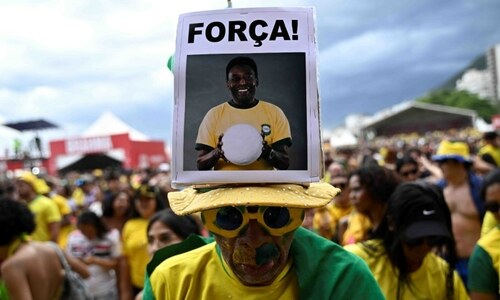
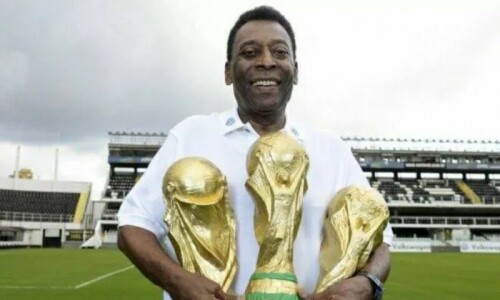
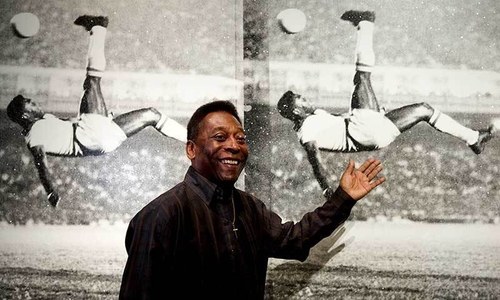
Brazilian ‘king of football’ Pele dies at 82


SAO PAULO: Brazilian football icon Pele, widely regarded as the greatest player of all time and a three-time World Cup winner who masterminded the “beautiful game”, died on Thursday at the age of 82, his family said.
“Everything we are is thanks to you. We love you infinitely. Rest in peace,” daughter Kely Nascimento wrote on Instagram.

Named athlete of the century by the International Olympic Committee in 1999, Pele is the only footballer in history to win three World Cups — 1958, 1962 and 1970.
Nicknamed “O Rei” (The King), he scored more than 1,000 goals in one of the most storied careers in sport, before retiring in 1977.
He had been in increasingly fragile health, battling kidney problems and colon cancer -- undergoing surgery for the latter in September 2021, followed by chemotherapy.
Born on October 23, 1940, in Brazil’s south-eastern city of Tres Coracoes, Edson Arantes do Nascimento — Pele’s real name — grew up selling peanuts on the street to help his impoverished family get by.
His parents named him for famed American inventor Thomas Edison.
But he was soon given the nickname Pele, for his mispronunciation of Bile, the name of a goalkeeper at Vasco de Sao Lourenco, where his footballer father once played.
Pele dazzled from the age of 15, when he started playing professionally with Santos. He led the club to a flurry of titles, including back-to-back Intercontinental Cups, against Benfica in 1962 and AC Milan in 1963.
Known for his genius with the ball, he epitomised the sublime style of play called “samba football” in Brazil, where he was declared a “national treasure”. He scored an all-time record 1,281 goals in 1,363 matches for Santos (1956-74), the Brazilian national team, and the New York Cosmos (1975-77).
But beyond his records, he will be remembered for revolutionising the sport, his ever-present number 10 on his back.
The first global football star, he played a lead role in the game’s transformation into a sporting and commercial powerhouse, tapping his preternatural athleticism despite his relatively small size — 1.70 metres (just under five-foot-seven).
He also played with heart, visible in the iconic black-and-white footage of the 17-year-old phenomenon bursting into tears after helping Brazil to its first World Cup title, in 1958.
Eight years earlier, seeing his father cry when Brazil lost the 1950 World Cup final at home to Uruguay, he had promised to bring the trophy home one day.
Pele reached the pinnacle of his greatness at the 1970 World Cup in Mexico, the first broadcast in color, where he starred on what many consider the greatest team of all time, with talents such as Rivellino, Tostao and Jairzinho.
He was often welcomed like royalty when traveling abroad with Santos or the national team. Legend has it in 1969 his arrival in Nigeria was the occasion for a 48-hour truce in the bloody Biafra war.
Pele declined offers to play in Europe, but signed for a brief, lucrative swan song with the Cosmos at the end of his career, bringing his star power to the land of “soccer.”
His reign extended beyond the pitch, with gigs as a movie star, singer and later sports minister (1995-1998) — one of the first black cabinet members in Brazil.
But he faced criticism at times in Brazil for remaining quiet on social issues and racism, and for what some saw as his haughty, vain personality.
Unlike Argentine rebel Diego Maradona, his rival for the title of greatest of all time, Pele was seen as close to those in power — including Brazil’s 1964-1985 military regime.
Final match
Pele’s public appearances had grown increasingly rare, and he frequently used a walker or wheelchair.
He was hospitalized several times for urinary infections, then again in 2021 and 2022 for the colon cancer that marked the beginning of the end.
But he met his health problems with trademark humor.
“I will face this match with a smile on my face,” he posted on Instagram in September 2021, after surgery to remove his colon tumor.
He was deeply moved when Maradona, his longtime friend and rival, died of a heart attack in 2020 at age 60.
“The world has lost a legend,” he wrote.
“One day, I hope, we will play soccer together in the sky. “
Published in Dawn, December 30th, 2022