Paris shooting suspect admits hatred of foreigners


 5
5


PARIS: A French man suspected of killing three Kurds in a Paris shooting last week has confessed to a “pathological” hatred for foreigners, Paris prosecutor Laure Beccuau said on Sunday.
The 69-year-old man was due to appear before a judge on Monday, prosecutors said. The suspect spent nearly a day in a psychiatric facility before being returned to police custody on Sunday afternoon.
Beccuau said in a statement that the suspect was “depressive” and “suicidal” and said he “wanted to kill foreigners” after a burglary in his home in 2016.
The shooting at a Kurdish cultural centre and a nearby hairdressing salon on Friday sparked panic in the city’s bustling 10th district, home to numerous shops and restaurants and a large Kurdish population.
Three others were wounded in the attack, but none are in a life-threatening condition, with one now out of hospital.
The suspect said he initially wanted to kill people in the northern Paris suburb of Seine-Saint-Denis, which has a large immigrant population. But he changed his mind as few people were around and his clothing made it difficult for him to reload his weapon, the prosecutor said.
He then returned to his parents’ house before deciding to go to the 10th district instead.
Clashes in Paris
The shooting has revived the trauma of three unresolved murders of Kurds in 2013 that many blame on Turkiye.
Many in the Kurdish community have expressed anger at the French security services, saying they had done too little to prevent the shooting.
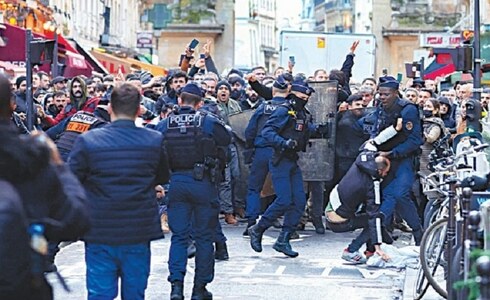
The frustration boiled over on Saturday and furious demonstrators clashed with police in central Paris for a second day running after a tribute rally.
The French capital’s police chief Laurent Nunez told BFM television channel that 31 officers and one protester were injured in the disturbances, while 11 people were arrested, “mainly for damage”.
Hundreds of Kurds in Syria demonstrated on Sunday in solidarity with the victims.
The suspect -- named as William M. by French media -- is a gun enthusiast with a history of weapons offences who had been released on bail earlier this month.
The retired train driver was convicted for armed violence in 2016 by a court in Seine-Saint-Denis, but appealed. A year later he was convicted for illegally possessing a firearm.
Last year, he was charged with racist violence after allegedly stabbing migrants and slashing their tents with a sword in a park in eastern Paris. The prosecutor said no links with an extremist ideology were found following a search of his parents’ home, a computer and a smartphone.
The suspect said he acquired his weapon four years ago from a member of a shooting club, hid it at his parents’ house and had never used it before.
‘He’s mad’
“He is mad, he is crazy,” his father said, describing him as quiet and reserved. He added that his son said nothing as he left his parents’ home on Friday.
Often described as the world’s largest people without a state, the Kurds are a Muslim ethnic group spread across Syria, Turkiye, Iraq and Iran.
Of the six victims of the attack, five were Turkish nationals and one was a French national.
Meanwhile, a top aide to Turkish President Recep Tayyip Erdogan blamed the street unrest that gripped Paris following the killing on outlawed PKK militants.
“This is PKK in France,” Erdogan’s foreign policy adviser Ibrahim Kalin tweeted, posting images of overturned and burning cars in Paris.
“The same terrorist organisation you support in Syria,” he wrote in apparent reference to the YPG.
The Kurdistan Workers Party (PKK) is designated as a terrorist organisation by Turkiye and its Western allies and has waged an insurgency against the Turkish state since 1984.
Ankara has been feuding with the United States and European powers about their support for Kurdish fighters in the People’s Protection Units (YPG) militia, which it says is the Syrian offshoot of the PKK.
The YPG played a central role in the US-led campaign against the militant Islamic State group in Syria.
It is not proscribed as a terrorist group by either the United States or the European Union -- an issue of constant tension in their relations with Nato member Turkiye.
“The same PKK that has killed thousands of Turks, Kurds and security forces over the last 40 years. Now they are burning the streets of Paris. Will you still remain silent?” Kalin wrote.
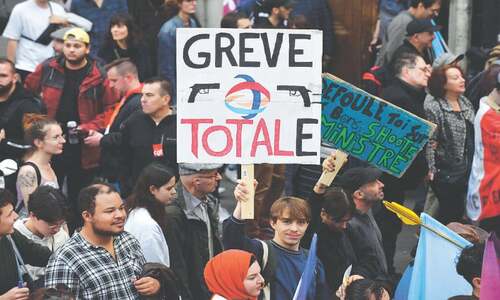
Some of the people who joined the subsequent protests chanted slogans mentioning the PKK.
Published in Dawn, December 26th, 2022