0
0


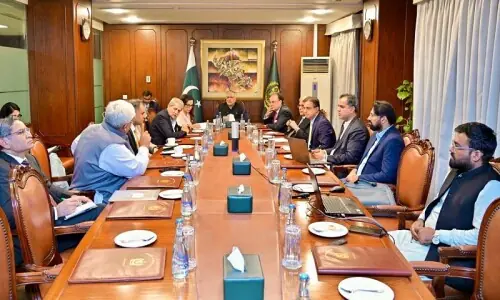
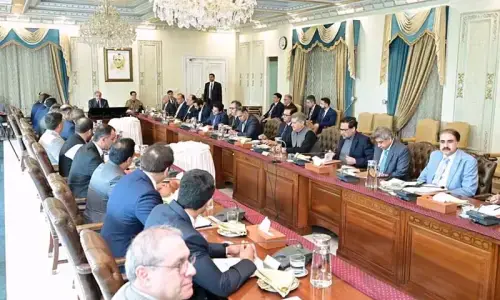
It’s good that Prime Minister Shahbaz’s economic team has realised that substantial help may not arrive unless Pakistan convinces the world with actions of its seriousness to do all within its means to beat the current crisis.
Before asking people and businesses to tighten their belts further and get ready to make sacrifices for economic survival or for donors to lend a helping hand, the government must lead by example. The public and business resentment looks perfectly logical when the government and its abnormally bloated machinery don’t appear to be austere. The donors also expect more measures to tackle the twin deficit.
“There is no defence for wasting public funds on avoidable travels, cars, plush offices, recruitment of pricy specialists when food, health, energy security of the country is at risk,” notes a business magnet. The donor of the last resort, the International Monetary Fund (IMF), is reported to have asked for details of the government roadmap ahead to deal with fiscal/current account deficits and piling circular debt in the energy sector.
The government’s recently proposed energy conservation plan to suppress the import bill has already been opposed by the Khyber Pakhtunkhwa government and businesses are expected to be affected by daylight saving measures (markets, restaurants, marriage halls, etc.)
It might serve the government well if economic ministers disentangle from politics to focus on sliding key indicators. High-level sources in Islamabad shared multiple instances when carefully designed briefs were ignored for weeks when every day matters.
Luxury cars for lackeys are allowed to slip in through the import restrictions while essential items such as medicinal chemicals are blocked
“After a detailed exercise, we put up a note on the economy in mid-November that we thought would set alarm bells in the government hierarchy and initiate a debate on the options mentioned. To our surprise, the minister, who we see debating actively on television every other day, didn’t bother even to open the file,” a senior bureaucrat told this writer.
It is already hard for the economically distressed majority to trust a system that has delivered little beyond promises. Now, if they learn that the government is blocking imports of necessities such as medicinal chemicals but letting luxury cars slip in for lackeys, they might not pardon those responsible.
The leaders need not be reminded that Pakistanis vote more independently than perceived. They are perfectly capable of turning tables on electable and their benefactors (e.g. the general elections in 1988).
“Democracy may still be young in Pakistan, but the political instincts of Pakistanis are fairly advanced, history has demonstrated repeatedly. People are neither thankless nor stupid. They reward sacrifices by politicians but tend not to forgive disrespect.
“It’s, therefore, silly on the part of the government to appease electable at the cost of the electorate”, said a frustrated business leader angry over the clearance of a bunch of luxury cars at Karachi Port when his consignment was stuck for weeks. He not only ended up paying high demurrage, but the consequent disruption in production could lead to the cancellation of export orders.
Discussing the lukewarm response of friendly countries, an expert remarked, “scaring allies with dire consequences of a failed nuclear state probably didn’t work in a world already threatened by fallouts of Ukraine war at the top of lingering effects of the pandemic. Begging and pleading in the name of the poor also falls on deaf ears when they see the government sharply chopping the development budget but indulging its brigade of ministers and loyalists in assemblies.
“The pleas for leniency from the IMF may not yield results as long as a blanket tax immunity is afforded to certain segments such as retailers, feudal aristocracy and money minting realtors.”
Talking on a popular podcast host last week Dr Asim Khawaja, an economist teaching at Harvard University Business School and associated with multiple research outfits and projects in Pakistan, pressed for attention to the transparency of processes adopted for declared goals.
He was frustrated over the gap between the economic potential and its actualisation in Pakistan but was hopeful that the current tough patch would pass eventually. His optimism, he said, was based on the trust in people and their skills to make the most of whatever was within their reach in an adverse situation.
“You can fool some people sometimes, but even the most wicked ones can’t expect to fool everyone all the time. The current coalition government may establish an upper hand over the opponents, but it can’t order economic indicators to fall in line. There is no shortcut. The government must take the pending issues by the horn and tackle them.”
“If the IMF is not comfortable with the finance minister, then instead of servicing his ego, the task needs to be assigned to someone else,” advised an economist. “The fact is that even friends like China, Saudi Arabia and UAE are waiting for an IMF nod before proceeding on their help commitments.”
A keen watcher of economic trends with his little finger in multiple pies shared his thoughts. “In the immediate term, I see no choice but to have a formally announced policy on rationing foreign exchange. It should not be ad hoc measures left to the State Bank of Pakistan; it requires a properly thought-through and well-debated cabinet decision.
“In the longer term, we need to rethink our energy consumption, particularly as it relates to transportation and climate control in buildings, as well as sourcing energy. Given our dire straits, this is the best time to convert to greater use of public transport (make cars prohibitive) and use railways, both for goods and passengers.
“For heating and cooling of buildings, I understand that a study at the Lahore University of Management Sciences indicates that 40 per cent of our entire energy consumption is for this purpose. If we design energy-efficient buildings, this consumption can be reduced significantly. Apart from focusing on renewables, and despite the negativity about coal, we must develop Thar, including its gasification.
“On the side of generating export earnings, as well as import substitution, the key is an investment in agriculture (higher exports as well substitute import of edible oils, lentils etc). If we can get our foreign exchange earnings and disbursements onto a sustainable balance, the other aspects of the economy should start falling in place”.
The writer can be reached at asubohi@hotmail.com
Published in Dawn, The Business and Finance Weekly, December 26th, 2022