ISLAMABAD: Within days after government’s two finance czars Miftah Ismail and Ishaq Dar openly differed on the country’s economic policy direction, Foreign Minister Bilawal Bhutto-Zardari and Minister of State for Petroleum Musadik Malik on Friday also took contradictory positions in the media on proposed discounted oil imports from Russia.
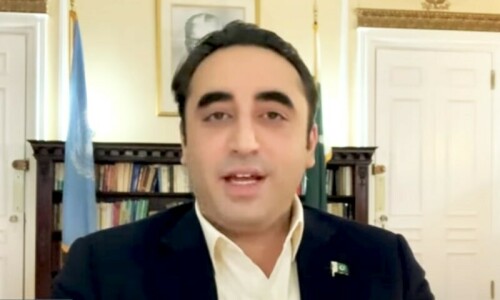
FM Bhutto-Zardari, in an interview to a US media outlet a day earlier, said Pakistan was not “pursuing or receiving any discounted energy” but facing an extremely difficult economic situation.
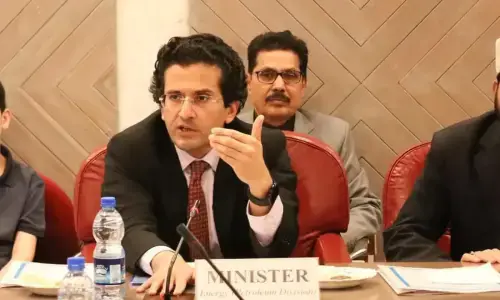
However, while contradicting his cabinet colleague’s statement, Minister of State for Petroleum Musadik Malik told the media Pakistan was very much pursuing discounted energy supplies from Russia whose energy minister was scheduled to visit Islamabad by mid-January to materialise those supplies to flow within four to five months.
But in an apparent attempt to dispel the impression of ‘conflicting positions’, the petroleum minister also said Bilawal’s statement was based on some ‘confusion’ that his ministry would explain in writing to the ministry of foreign affairs.
Bilawal’s statement based on some ‘confusion’, says Musadik Malik
He said the foreign minister’s statement to the extent that Pakistan ‘is not receiving’ any discounted energy from Russia was “factually correct”, as no supplies were taking place at the moment. He told a presser that during his recent visit to Moscow, Russian side had “clearly assured” Pakistan of supplying crude oil at the same discounted rates given to any other countries or even at higher discount.
Two of the eight Russian crude oils — Siberian light and Urals light — could be processed at the rate of 50pc and 30pc, respectively, at state-run Pakistan Refinery and Pak-Arab Refinery, respectively, while Cynergico Refinery could process all six other heavy crudes, the minister for petroleum explained.
The specifications had been discussed with the refineries before the visit of his delegation to Moscow, he recalled, adding that Russians had also offered to provide blended crude oils which could be refined at refineries in Pakistan.
Russia also promised to supply petrol and diesel to Pakistan for which negotiations would be held to secure discounts, which are equivalent or even lower than those available to other countries, he noted.
In response to a question, the petroleum minister claimed that he had not listened to the statement of Foreign Minister Bhutto-Zardari in the US, but on the basis of what had been told to him he said there seemed to be some confusion.
“We lacked something that we should have given in detail to Foreign Office,” the minister said, adding that his ministry would clear all misperceptions to FO in this regard as the Pakistani ambassador to Moscow had been part of the negotiations with Russia on oil import during the Pakistani delegation visit earlier this month.
He said the visit to Russia had been very positive regarding crude oil imports from Russia. The transactions when materialized at discounted rates would reduce the cost of energy and thus reducing the cost of production of everything, including storage and transportation, and ultimately benefit the people, he believed.
Mr Malik said a delegation of the Inter-Governmental Commission, led by Russian energy minister, would visit Pakistan in the second week of January to finalise matters related to the import of crude oil, diesel and petrol. He said Pakistan was also nearly ready to sign a trade agreement with Azerbaijan on LNG that will enable Pakistan to buy any distressed cargo across the world at cheap rates.
“We have already exchanged draft of the agreement that would be signed within a couple of weeks. Special strategic cell” had been created in the petroleum division to ensure timely implementation of any agreements and such initiatives like import of discounted oil from Russia, piped gas from Turkmenistan, oil import from Kazakhstan, oil and LNG from Azerbaijan and additional oil cargos from the United Arab Emirates, he added.
The minister said Pakistan was trying to sign a government-to-government agreement with the UAE through which Pakistan would get one or two additional cargos of petrol and diesel per month.
Pakistan, he said, had also revived the Turkmenistan-Afghanistan-Pakistan gas pipeline project for import of 1.3 billion cubic feet of gas per day. “We have given our commitment and we have secured their commitment to revive and push the project,” he said.
Published in Dawn, December 17th, 2022