ISLAMABAD: As an international safety accord renowned for its work in transforming the workplace safety system for millions of garment workers in Bangladesh has now expanded to Pakistan, workers recalled how they fell victim to exploitation by factory owners.
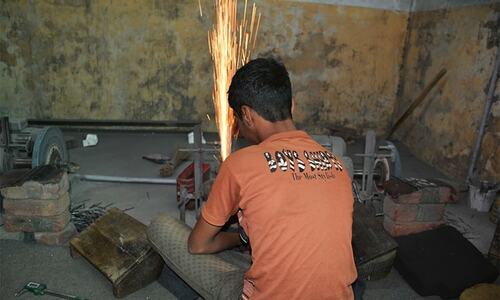
Pakistani workers and union leaders, during an online discussion, informed policymakers in Belgium and the Netherlands that the government of Pakistan and the European Union were very lenient over the exploitation of textile workers in Pakistan at the hands of factory owners.
Seemi Mustafa, a victim of exploitation by owners of a denim factory in Karachi, narrated her ordeal and said that salaries of several female workers had not been paid by the management of the factory.
“I, along with my younger brother, were even beaten only because we demanded that our wages be paid and we were not even paid the amount of wages that was agreed at the time of employment,” she said.
Plan ensuring workers’ safety to be launched next month, expected to cover more than 500 factories, mostly in Sindh, Punjab
She further said that female workers continued to be exploited, abused and threatened to stay quiet only because they were poor and had no voice.
Ms Mustafa recalled that initially she lodged the complaint with the Sindh Labour Department but, after five months of hearings, the department told “me that the matter related to police”.
The International Accord for Health and Safety in the Textile and Garment Industry is set to be launched next month and is likely to establish and ensure a stringent monitoring mechanism to prevent mistreatment and exploitation of workers, especially women, in Pakistan’s textile sector.
The accord, to be known in Pakistan as the Pakistan Accord on Health and Safety in the Textile and Garment Industry, would be a legally binding agreement between global union federations, UNI Global Union and IndustriALL Global Union and garment brands and retailers, and would take effect from Jan 16.
In Bangladesh, the plan was initially established in 2013 in response to the collapse of Rana Plaza and other factory disasters that resulted in more than 1,000 deaths and thousands of injuries.
Pakistan’s textile and garment exports amount to around $20 billion annually and the Pakistan Accord is expected to cover more than 500 factories, mostly located in Sindh and Punjab.
Zehra Khan, secretary general of Home-based Women Workers Federation (HBWWF), the first trade union of home-based workers in Pakistan, said that informal work had been on the rise in the country.
“Home workers are an essential part of the value chain, with an even larger share of women than in factories but these workers receive no contracts, have no social security and are paid about one-third of the minimum wage,” Ms Khan said.
She said that other aspects of informalisation were short-term jobs at factories and work without contracts.
Nasir Mansoor, Secretary General of National Trade Union Federation Pakistan (NTUF), called upon policymakers in the EU and North America to implement stringent checks to ensure that top brands of the world did not get products from outlets where workers, especially women, were exploited, underpaid or worked under insecure and unsafe conditions
“We need to have some pressures from the EU that all workers be unionised, which is not the case of even five per cent workers working in the textile sector of Pakistan,” Mr Mansoor said.
Ineke Zeldenrust, international coordinator of the Clean Clothes Campaign network, said that many textile units got the jobs done from a subsidiary, but the new accord would help textile and garment workers with a platform to lodge their complaints against violations at the workplace.
Published in Dawn, December 16th, 2022