ISLAMABAD: The counsel for PTI Chairman Imran Khan on Tuesday told the Supreme Court that its question about his client’s opinion on exclusion of the armed forces from the purview of NAB law was a political one.
Advocate Khawaja Haris explained that the 2001 judgement in Asfandyar Wali case had already justified why the armed forces did not fall within the ambit of the accountability law, saying the Pakistan Army Act 1952 as well as the Pakistan Army Act Rules 1954 were self-contained codes, which provide for prosecution and punishment in cases involving corruption, corrupt practices and illegal gratification, besides enjoying constitutional protection.
However, members of the armed forces in federal and provincial corporations are not immune from the accountability process, the counsel explained, adding that the serving army officers can be tried under the corruption law but only after their retirement.
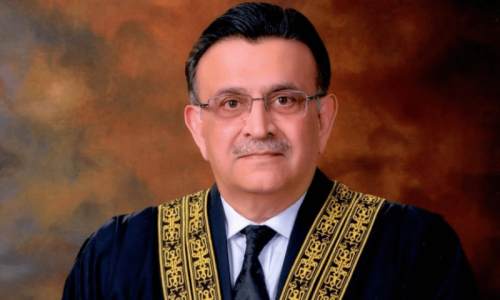
Khawaja Haris was arguing before a three-judge SC bench, headed by Chief Justice of Pakistan (CJP) Umar Ata Bandial, which was hearing Imran Khan’s challenge to the amendments to the National Accountability Ordinance.
Justice Mansoor questions officers’ exclusion from NAB law’s purview
Justice Syed Mansoor Ali Shah, a member of the bench, wondered why the officers employed by the military-owned organisations like the Army Welfare Trust are out of the ambit of NAB law, but not those who are serving in the federal and provincial corporations.
“I simply wanted to understand why the members of the armed forces have been taken out especially when Article 25 of the Constitution talks of equality of citizens?” the judge asked. Though the army officers could be expelled from service on corruption charges, still the ill-gotten assets could not be recovered, he wondered.
Justice Shah conceded that the serving army officers have been made immune from the ambit of the NAB law to maintain discipline and administrative control, but “we are talking about the corruption done by the officers in their individual capacity”.
The court can revisit the Asfandyar Wali case for further clarity, said the counsel.
“You wanted the court to revisit the case,” Justice Shah said, asking who was in the government when the judgement came.
The counsel said it was the government of Gen Pervez Musharraf, but hastened to add that the court should not shift the burden on “our shoulders”.
Regarding amendments to the NAB law, CJP Bandial asked if a truncated assembly could amend the accountability law, wondering how the court could deal with an assembly which has not been properly constituted and so many of its members have boycotted it and chosen to go out of parliament.
Justice Ijaz-ul-Ahsan regretted the unduly haste in which the amendments were rushed through, adding that literally nothing was on record to explain what was the motive and purpose behind adopting the amendments by the assembly.
He regretted that political parties follow lines given by individuals, which usually lead to self-interest, adding that there were 250 cases against those individuals who benefited from the NAB law yet they guided amendments.
When the CJP asked if it could be called parliamentary capture, the counsel explained that it was akin to regulatory capture done in a blatant manner and the court should not close its eyes, rather intervene.
The CJP regretted that corruption was still taking place as the executive had made no effort to improve the law, adding that even the judiciary was not able to suggest a way out as a result of which “we could see inspector generals and SHOs being transferred every now and then”. “We should be focusing on implementation of the law to ensure transparency,” the CJP observed.
Published in Dawn, December 14th, 2022