Nasa’s Orion capsule returns to Earth after flight around moon


 2
2


Nasa's Orion capsule barreled through Earth’s atmosphere and splashed down in the Pacific ocean on Sunday after making an uncrewed voyage around the moon, winding up the inaugural mission of the US agency’s Artemis lunar programme 50 years to the day after Apollo’s final moon landing.
The gumdrop-shaped Orion capsule, carrying a simulated crew of three mannequins wired with sensors, plunked down in the ocean at 9:40am PST (1740 GMT) off Mexico’s Baja California peninsula, executing a key demonstration of how future lunar astronauts would safely return to Earth.
“From Tranquility Base to Taurus-Littrow to the tranquil waters of the Pacific, the latest chapter of Nasa’s journey to the moon comes to a close. Orion, back on Earth,” said Rob Navias, a Nasa commentator speaking on a live stream.
The splashdown capped a 25-day mission less than a week after passing about 79 miles (127 km) above the moon in a lunar fly-by, and came about two weeks after reaching its farthest point in space, nearly 270,000 miles (434,500 km) from Earth.
The capsule at 9am PST committed to its fiery, 20-minute plunge at 24,500 miles per hour (39,400 kph) into Earth’s atmosphere when it shedded its service module, exposing a heatshield that reached peak temperatures of nearly 5,000 degrees Fahrenheit (2,760 degrees Celsius).
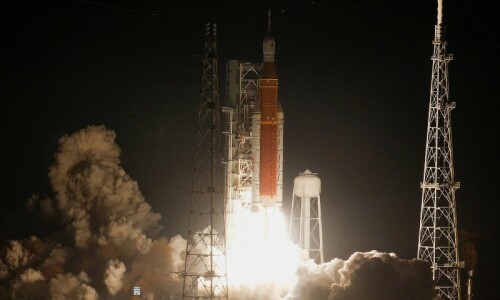
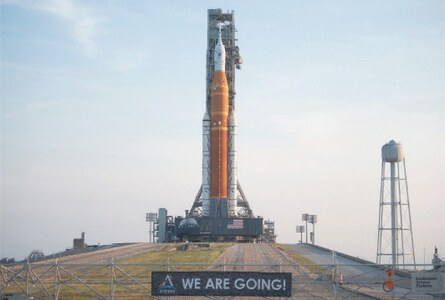
Orion blasted off on Nov 16 from the Kennedy Space Centre at Cape Canaveral, Florida, atop Nasa’s towering next-generation Space Launch System (SLS), now the world’s most powerful rocket and the biggest Nasa has built since the Saturn V of the Apollo era.
The debut SLS-Orion voyage kicked off Apollo’s successor programme, Artemis, aimed at returning astronauts to the lunar surface this decade and establishing a sustainable base there as a stepping stone to future human exploration of Mars.
By coincidence, the return to Earth of Artemis I unfolded on the 50th anniversary of the Apollo 17 moon landing of Gene Cernan and Harrison Schmitt on Dec 11, 1972. They were the last of 12 Nasa astronauts to walk on the moon during a total of six Apollo missions starting in 1969.
Re-entry marked the single most critical phase of Orion’s journey, testing whether its newly designed heat shield can withstand atmospheric friction and safely protect astronauts that would be on board.
“It is our priority-one objective,” Nasa’s Artemis I mission manager Mike Sarafin said at a briefing last week. “There is no arc-jet or aerothermal facility here on Earth capable of replicating hypersonic re-entry with a heat shield of this size.” If Artemis I is deemed a success, a crewed Artemis II flight around the moon and back could come as early as 2024, followed within a few more years by the program’s first lunar landing of astronauts, one of them a woman, with Artemis III.
Though the capsule encountered some unexpected communication blackouts and an electrical issue during its voyage around the moon, Nasa has given high marks to the performance of both SLS and Orion so far, boasting that they exceeded the US space agency’s expectations.
Published in Dawn, December 12th, 2022