You are a fisherman trying to earn a modest livelihood against all odds. One day, you are braving the high waves in your small wooden boat and, another day, you cannot get much of a catch due to overfishing. Yet another day, you find yourself in the wrong place at the wrong time, with the Indian coast guard after you.
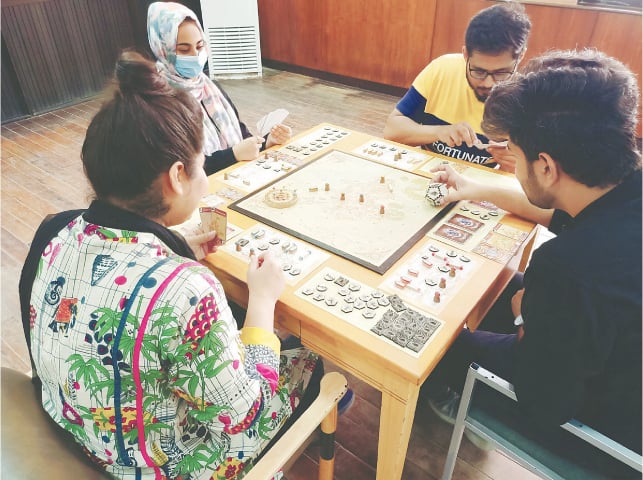
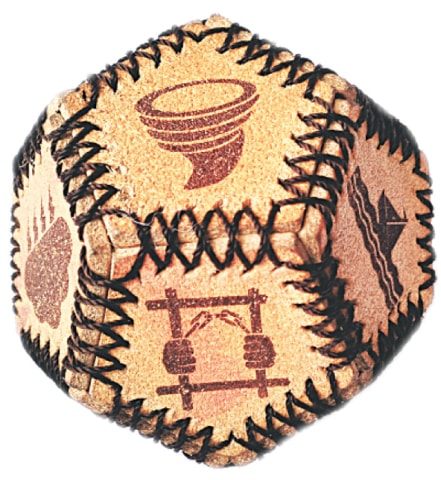
And just when you think that your goose is cooked, you roll that 12-sided leather dice, get your turn to spin the traverse board and reach for another action card. You breathe a sigh of relief as you have a chance to review your options before making your next move.
You are playing Machi Wachi, a board game created by two artists, Taqi Shaheen and Sara Khan Pathan, after eight years of careful research about Bhit Island’s ecology.
Their collaborative research anchors itself on empathy, love and understanding of the indigenous fisherfolk communities of Karachi, their multi-generational histories and the coastal conditions, using art, design, educational formats, films, storytelling and interactive media.
Two artists and educators create an environmental strategy board game that acts as a storytelling interface to help people better understand climate-induced disasters and the scarcity of natural resources faced by Karachi’s fishing community
Taqi is an artist and filmmaker whose work crosses mediums to create curious observations on contemporary subcultures, alternate histories and mediascapes. He uses trans-media formats to research and construct non-fictional narratives through films, exhibitions and publications. His non-fiction works include Afterimage: a VR Experience, Subjective Atlas of Pakistan (Oxford University Press, 2020), Drawn Attack, Lessons on Lessons, The Petman Girls, Whose Pakistan is it Anyway? and an animated short film, Congregation of the Distressed.
Sara is a multidisciplinary artist and educator working in sculpture, illustration, animation, photography and painting. Her art is born from her resolute devotion to Pakistan, exploring cartography, nature, impacts of violence, displacement and sociopolitical complexities.
A few of her recent projects include the conceptualisation and curation of tactual art for the visually impaired, based on master-painter Sadequain’s work, for the Chalta Phirta Museum at the State Bank Museum in Karachi, and the co-curation of the South Asian food anthology book ‘Manachi’. She is also the original concept/illustration artist for the design inspiration of the reverse vinaigrette of the 75th commemorative banknote published by the State Bank of Pakistan. Besides this, Sara is a miniature painting instructor and also a thesis advisor at the Department of Visual Studies at the University of Karachi.
It was the artists’ research at Bhit Island which fed into the creation of the board game. Machi Wachi is set around Bhit Island. To play the game, you take on the role of local fishermen trying to navigate their way through the climate-induced struggles they face.
“The game puts you in the shoes of local fisherfolk to see what it is like to face calamities and what choices you make to save yourself,” Taqi tells Eos. “We wanted to have a format which was imaginative, playful and engaging, so that players from anywhere in the world could relate to it.
“That’s also why we created the game in collaboration with the community on Bhit Island. This is an island which lacks all the resources and basic necessities of life. It has also experienced a lot of calamities in the past,” he points out.
He says they named the game Machi Wachi as ‘machi’ in the Kutchhi language means fish and ‘wachi’ is generic for other things.
“Since it is an environmental strategy board game, it makes you focus on natural resources and the different kinds of issues, such as sea level rise, deforestation, overfishing, oil spills, coastal erosion, etc that the islanders and we are facing at large,” he says.
According to Sara, the game can be played by two to four people. You can be the nakwa or boat captain, the greejar or mechanic, the khalasi or gofer and the seth or boat owner. “Each player has a tribe of his own and four boats to navigate the sea. The goal is to survive on the island and off it. Alongside, you secure and use your natural resources such as fish, water, the mangrove trees, etc.
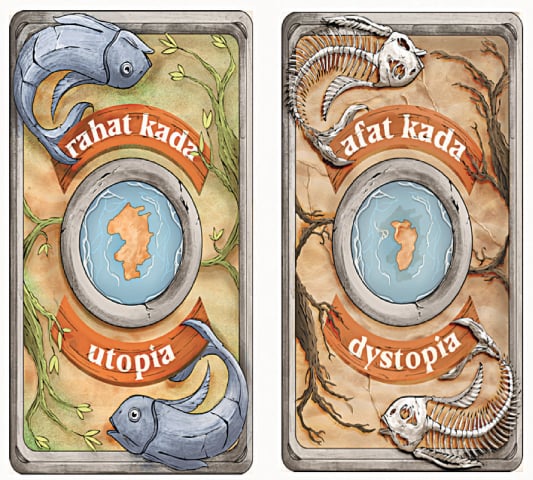
“You also have access to action cards that can be a plus or minus for you. These are dystopia cards and utopia cards. They are called afat kada (dystopia) and rahat kada (utopia). So, dystopia cards could mean tsunami warnings, storm alerts, dredging, coastal erosion, real estate dreams, short-term development goals, sea level rise, which is one of the main situations you encounter during the game. Meanwhile, utopia is the aspirations and dreams of the islanders,” she says.
“Machi Wachi also highlights the scarcity of natural resources, which the islanders face, such as clean drinking water, electricity and gas. I feel it is very unfair not to think of or help the community that actually does the hard job of catching fish from the ocean while we, in the city, get to eat it as a luxury on our tables,” says Sara. “The game has mapped stories and facts which have never been recorded or told before,” she adds.
“The fishermen community is the oldest community of Karachi. If we don’t know about these communities, then how is it possible for us to address the problems being faced by the city itself?” Taqi asks.
The game is still at the prototype stage but it is certainly timely, as Pakistan has been grappling with one of the worst climate-induced disasters in years.
“While we were developing this game, Karachi was facing the worst form of urban flooding,” says Taqi. “Even right now, many parts of the country are under water. The situation is terrible and we are in it together. We have to sit on the table to discuss all these issues side-by-side, so that we understand the extent of calamities.
“We need to learn to solve our own problems rather than look towards the gora [Westerners] for help. The game board is also a problem-solving inter-base. Pakistan has recently seen its worst climate-induced natural disaster in years caused by melting glaciers in the country’s northern mountains and record rainfall.
“And it is not that it is happening to just Pakistan. Unfortunately, we ended up being one of the first victims of all these things. But down the line, it could be anyone else in the world,” adds Taqi.
How do you win the game?
“Well, when it comes to climate change, there are no winners or losers. There are survivors. The goal of the game is to survive. It has a sustainability track. If you have used your resources responsibly, if you have placed your resources at the right places, you end up surviving,” he says.
The writer is a member of staff.
She tweets @HasanShazia
Published in Dawn, EOS, December 11th, 2022