KARACHI: The penultimate day of the 15th International Urdu Conference held at the Arts Council on Saturday began with an extremely thought-provoking session on Urdu poetry in the 21st century. It was moderated by Shakil Jazib and presided over by poets Amjad Islam Amjad and Iftikhar Arif.
Sofia Lodhi read a paper on Urdu nazm’s feminist perspective. She said although there have been only two decades in the 21st century, many an event has affected the social fabric of the world. The events included 9/11 and the Covid pandemic, among other. The challenges posed by them are changing the norms of society. In such a situation, women’s sensibility is markedly different from those of men’s, and all such aspects seep into the former’s poetic content.
Ashfaq Husain talked about Urdu poetry written in other parts of the world. He said the poems penned in the West are an extension of what’s being written in Pakistan. He took names of many quality poets in support of his argument, such as Ahmed Mushtaq and Irfan Sattar, and quoted a couplet by Sattar as well.
Journalist Asma Shirazi’s book Kahani Barey Ghar Ki launched at the third day of Urdu Conference
Terey lehjey se tera jahl-e-darun bolta hai
Baat kerna nahin aati hai to kyun bolta hai
[Your conversations reveal your uncouthness within
Don’t speak if you can’t articulate yourself]
Dr Ziaul Hasan’s paper was on the Urdu ghazal. He said things are shaping up in the 21st century. The diction and narrative of the ghazal has changed in the last 30 years. The thing with ghazal is that poets use words creatively when employing the genre. It has been seen over several periods of time that the language used in ghazal becomes the language of everyday use.
Khalid Mahmud Sanjarani said for the last 30 or 40 years, writers have been facing the globalisation onslaught. But gradually, in the 21st century, localisation is taking over. In eight to 10 years, we’ll get to see local content in poetry. “It’s a blessing of our region that it’s a jungle of languages.”
Tanveer Anjum talked about prose poetry, which has been in practice for the last six decades, and shed light mostly on those poets in whose poetry women don’t feature.
Ambareen Haseeb Amber’s topic was the genre of ruba’i. She pointed out that in modern-day ruba’i poets have begun to use English words. It also contains feminist consciousness (nisa’i shaoor).
Amjad Islam Amjad took issue with the title of the session arguing that 90 to 95 per cent poets, who are writing in the 21st century, began doing that in the 20th century. He was of the view that poets such as Dr Waheed Ahmed have been overlooked. He highlighted that while in the coming 10 years, poets will be doing their job, the quality of audience will not be the same [it’s on the decline].
Iftikhar Arif summing up the papers that were read said no one can tell a poet what to write and what not to express their feelings about. “One of the strongest traditions of modernism is to do with feminism. No artist can have universal appeal without being local. And the circle of Urdu poets’ listeners is shrinking.”
‘Translation bring together two cultures’
A very important post-lunch session was the launch of three books.
Moderated by Nasra Zuberi, the first of them was the fourth collection of Nasir Abbas Nayyar’s short stories Aik Zamana Khatm Hua. The titles of his collections are just as unique as the stories. Aik Zamana Khatma Hua is taken from a line from Majeed Amjad’s poem. The book has 12 stories.
Rahman Faris’s translation of Pablo Neruda’s poems titled Muhabbat Ki Sau Nazmein was the second book. He said translation brings together two cultures. “Abbas Tabish gave me the idea. While reading Neruda’s poems I realised that the flavours that his poems carry can’t be found in Persian or Urdu literatures.”
The third and last book launched at the programme was Tanveer Anjum’s Sar-o-Bar-i-Aarzu. Anjum said she wrote the poems included in the book in different phases and in a short span.
Syed Kashif Raza, giving his opinion on her poems, said that she wrote them with shahzadgi (in a princely or royal way).
‘Writing a good column is not easy’
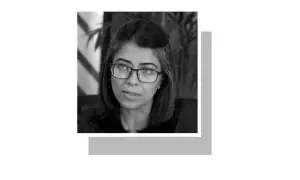
The launch of journalist Asma Shirazi’s book Kahani Barey Ghar Ki — a collection of her columns — moderated by Wusatullah Khan generated an interesting set of opinions.
Media person Sohail Waraich said column writing is so easy that any can take it up, but it is equally difficult as to how to write a good column. This is the reason that there are very few quality columnists around. [A worthy column] is to do with its content, style of writing and balance. Over a period of a time, Shirazi has learnt to say the most difficult things with ease.
Journalist and anchorperson Hamid Mir said anyone who wants to know what’s inside Shirazi’s book without reading it, reading its title would suffice. The book is beautiful both on the inside and outside. The most prominent aspect of the publication is its name — the story of the big house. “Actually, it’s the tale of conspiracies that take place in power corridors. The author has used a ‘big’ house in Islamabad as the symbolic title for her book.”
Published in Dawn, December 4th, 2022