KARACHI: The future would see Artificial Intelligence as the third revolution in warfare being utilised with minimal adverse impact. This augments the implications of AI on national security, military tactics, and defence strategies as almost 70-75 per cent of global defence leaders believe that AI will be very or extremely important to organisational strategies and in bearing outcomes.
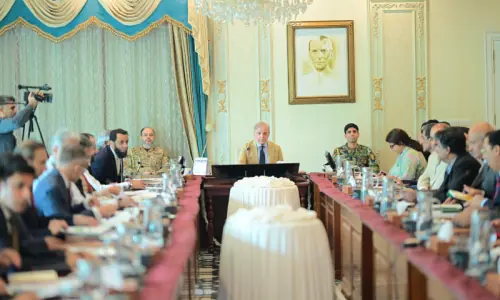
This was highlighted during the first day of a seminar titled ‘Artificial Intelligence in Defence Market: A Paradigm Shift in Military Strategy and National Security’, organised at the Expo Centre, Karachi, on Tuesday as a part of IDEAS-2022 in joint-collaboration with the Institute of Policy Studies (IPS), Islamabad and the Defence Export Promotion Organisation (DEPO).
Defence Production secretary retired Lt Gen Humayun Aziz termed AI as an aspirational goal, a game changer, and a transformative national security technology that is opening up several prospects of military success as well as threats to defence and security.
“The major areas of national security, which would see a significant impact from the increasing developments in AI are military superiority, information superiority and economic superiority through data, data-driven technologies, machine learning technology, network technologies, and cyber defence technology,” he said while speaking as the chief guest.
At IDEAS opening day, defence production secy says technology won’t curtail reliance on conventional capabilities
Regarding the future dynamics of the international security environment and strategic shifts in defence, he noted that these are dependent on AI and AI-driven applications, which have now become key pillars of states. However, these developments would not curtail the significance and reliance on conventional capabilities in mitigating and combating threats.
“The transformation of warfare through AI, along with biotech, strategic weaponry, and computers, would increase armed forces’ readiness and bring a paradigm shift in modern warfare and the security apparatus of states,” he further maintained.
While highlighting the globalisation of weapon systems and advancements in AI, DEPO director general Major General Mohammed Arif Malik emphasised that new technologies have ushered increased opportunities, demands, and investments in the development of AI-integrated systems in the defence and security domain.
He advocated for building awareness for the use of AI and AI research in the fields of intelligence collection and analysis, logistics, robotics, cyber missions, information operations, C2, and autonomous weaponry for better incorporation of AI into real-world military operations globally.
Emphasising the importance of investing in AI, he underlined that AI is changing not only the living styles, employment performances, people-to-people interaction, learning, and decision-making of people as well as the operational and business environment of organisations, but also military tactics and warfare.
In this regard, significant capitalisation of AI has been seen in hybrid, cyber, and network-centric warfare.
As put by Lars G.A. Hilse, a German scholar and global thought leader in the field of digital strategy and cyber security, the current AI applications in hybrid warfare through fake news, misinformation, disinformation, cyber-physical attacks on civilian infrastructure, opinion manipulation, and adversarial reconnaissance and intelligence gathering triggers civil unrest and have serious security and economic implications.
“Similar is the case with the use of AI in cyber security which demands a defence approach and practical steps towards a robust security framework based on identification and prioritisation of critical infrastructure, efficient legislature, regular stress and penetration tests, continuous vulnerability testing (CVT), and multi-layered neural networks,” he outlined.
The 5G Network Centric Warfare (NCW), as underlined by Dr Sigit Jarot, CEO Cloudtech and Head of Infrastructure, MASTEL, Indonesia, is increasingly becoming relevant as information and AI-driven technologies are employed to gain information advantage to convert it to a competitive advantage. “Future battles would entail the weaponisation of 5G. Therefore, it calls for an approach to study and develop 5G for future military endeavours including 5G military decision-making, 5G smart warehousing, 5G distributed C2, 5G AR/VR, 5G for tactical millimeter wave networks, 5G non-terrestrial networks, proximity services (ProSe), and 5G geo-intelligence,” he further noted.
The event was attended by various foreign dignitaries, high-rank government officials, ministries, academics, think tanks, representatives from public and private industries and law experts.
Published in Dawn, November 16th, 2022