0
0


ISLAMABAD: Pakistan National Council of the Arts (PNCA) and Nomad Art Gallery here on Tuesday kicked off various week-long art activities to celebrate cultural diversity of Pakistan and create social harmony through soft expressions of art.
The activities including a group art exhibition, performance, workshops, storytelling and seminar by various artists would continue till Nov 16.
The opening show was a group exhibition of paintings and art pieces titled Diversity and Social Harmony made by various artists featuring traditional and contemporary arts.
The exhibition showcased an exquisite collection of artworks, including paintings and ceramics.
The event was a collaboration between Nomad Gallery and PNCA featuring artists such as S Najam Kazmi, Samina A Akhtar, Zafar Ali, Khurram Abbas, Hassan Sheikh, Areej Nasir, Emaan, Tauqeer Hilbi, Alefiya, Rakshanda Atawar, Hassnain Awais, Nabahat Lotia, Jamil Hussain and Kuzhad.
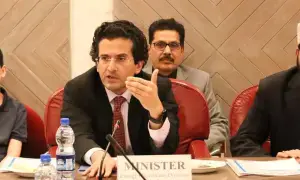
The event was inaugurated by Ambassador of European Union, Riina Kionka who appreciated the role of Pakistani artists for contributing into the art scenes through diverse cultural expressions and mastery of techniques.
Director general of PNCA Ayub Jamali on the occasion said the event was an attempt to bring various established artists under one roof for the promotion of cultural heritage.
“Pakistani art has a long tradition and history and Pakistani artists are talented. It consists of a variety of art forms including painting, sculpture, calligraphy, pottery and textile arts such as woven silk.
“The arts are a vehicle through which human beings cultivate distinct social, cultural and individual identities while transmitting values, impressions, judgments, ideas, visions, spiritual meanings, patterns of life and experiences across time and space,” said Nageen Hyat, curator of the show and director of Nomad Gallery.
She said that traditional art was important as it was passed down through generations and provides a shared experience for the entire community.
With values, cultural practices, and belief systems embedded in these art forms, they often form a common language through which the different communities that fabricate the society can be engaged.
“Pakistan’s culture was diverse and had always found itself rooted in traditions along with art. It could be seen through the various monuments and iconic architectural structures across the country that was testament to its glorious history. Culture and creativity here manifest themselves in almost all economic, social and other activities,” she added.
Najam Kazmi was working as a miniature, contemporary and traditional artist since 1989 to date. He was conferred the Tamgha-i-Imtiaz by the government of Pakistan and honoured with the life time achievement award by the Rawalpindi Arts Council (RAC). He exhibited in countries including Turkey, Iran, Algeria, Sri Lanka, India and the Gulf.
Senior artist Samina A Akhtar has also exhibited in multiple countries while Khurram Abbas’s work was based on social injustice and his war trauma.
He painted memories in his painting, the visuals of which helped him alleviate their impact. His work was meant to be an expression of protest in silence.
“As an artist, I am mostly concerned about various issues relevant to my cultural background and most of my works reflect multiple social, political, and religious aspects as well as racism, sectarianism, injustice, and terrorism, which are inter-connected at some levels. Being artists, we are citizens and get easily affected by the actions and extremism taking place in our surroundings. And I am always keenly observing human behaviour rapidly changing in my surrounding,” said Zafar Ali about his work.
Hassan Sheikh said, “During my early years experimenting in the field, I realised that to most South Asians, miniature is only an ancient artistic expression used during pre-colonial times. Thus, I began my art practice by exploring ways to develop the expression such that it becomes relevant in today’s context.”
Rakhshanda Atawar’s work, with a portfolio expanding three decades, freely reflected use of rich colours, the effort guided by emotional outbursts. The latest series was heavily influenced by one considerable factor, having to remain in lockdown during the pandemic.
Published in Dawn, November 9th, 2022