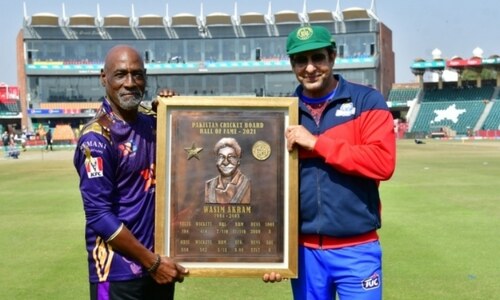
Tragedy convinced Wasim Akram to ditch cocaine habit


 31
31


LONDON: Pakistan cricket legend Wasim Akram says it took the death of his first wife Huma to spark him into finally kicking his addiction to cocaine which had replaced the thrill of playing when he retired.
Wasim, a key member of the Pakistan side that won the 1992 World Cup told the Sunday Times it was Huma who “found me out” and advised him to seek help.
However, that did not work, Wasim said in an interview to promote his new autobiography “Sultan: A Memoir”, because “the doctor was a complete con man” and he returned to taking cocaine.
It took Huma’s death aged just 42 in October 2009 to finally persuade him to give it up.
Wasim said “the culture of fame in south Asia is all-consuming, seductive and corrupting” and he fell into that trap after he retired in 2003.
“It was a substitute for the adrenaline rush of competition, which I sorely missed, or to take advantage of the opportunity, which I had never had. My devices turned into vices.”
The 56-year-old former pacer said he first took cocaine when he was offered some at a party in England.
“My use grew steadily more serious, to the point that I felt I needed it to function,” he said.
Huma lived between England and Lahore with their two sons, Tahmoor and Akbar, but felt isolated as Wasim’s media commitments took him all over the world.
“It (cocaine) made me volatile,” he said.
“It made me deceptive. Huma, I know, was often lonely in this time . . . she would talk of her desire to move to Karachi, to be nearer her parents and siblings.
“I was reluctant. Why? Partly because I liked going to Karachi on my own, pretending it was work when it was actually about partying, often for days at a time.”
Wasim agreed with Huma he needed help after her “discovering a packet of cocaine in my wallet.”
“I couldn’t control it,” he said. “Four (lines) would become a gram, a gram would become two.
“I could not sleep. I could not eat. I grew inattentive to my diabetes, which caused me headaches and mood swings.”
Published in Dawn, October 31st, 2022