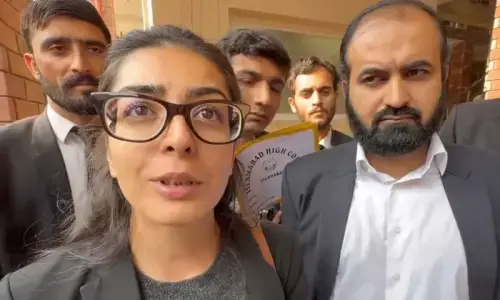
LAHORE: In a session on the concluding day of the Asma Jahangir Conference, while on one hand activists attempted to explain to the audience what the transgender rights law was all about, religious leaders stressed it needed to be in line with Islamic principles.
The session, ‘Transgender Rights Law Under Threat and the Plight of the Community in Pakistan’, was moderated on Sunday by lawyer Reema Omer.
In her keynote address on the occasion, National Commission for Human Rights (NCHR) Chairperson Rabiya Javeri Agha talked about incidents of violence against transgender persons and how the killers have never been punished.
She also referredto the Khaki vs Rawalpindi case of 2009 that argued that the transgender community needed legal representation and equal treatment as granted under the Constitution.
“These directions under the judgement were realized in the 2018 transgender rights law; it’s not about homosexuality, gay marriage. It establishes the right to self-identify – the right of a person to choose their legal sex based on their perception of their gender, what you feel inside.”
She questioned why the transgender community should be subjected to the humiliation of a test for getting an identity card when a man or woman wasn’t.
“Rolling back of the law has made a vulnerable community extremely more vulnerable now,” she concluded.
Senator Kamran Murtaza of the Jamiat Ulema-i-Islam-Fazl (JUI-F) attempted to clarify how religious parties were not opposed to the law, and claimed the community was being exploited by society as a whole and not by the religious circles.
“If the Constitution and law gave them all the rights, there should not have been any problem, but since they didn’t, it means the problem lied somewhere else. We want to correct the law; our issue is Islam, religion.”
Explaining the concerns with the law, the senator said the idea that a person chose their gender based on their perception was problematic; genders were determined on physical features.
These things were in turn related to issues of inheritance among others, so if there was any ambiguity over a gender, a medical board could be engaged for clarification, otherwise perceptions would create many issues, he added.
Researcher and activist Mehlab Sheikh charted the history of violence, discrimination and persecution of the community since the British era.
She explained the law, in essence, was anti-discrimination and saved the community from embarrassing procedures to determine their genders, and provided mechanism to report gender-based violence through gender expression and identity.
“Once again, a moral panic has been created that the law endangered family values and promoted homosexuality. Transgender persons were only being scapegoated,” she added.
Activist and Transgender Protection Unit in-charge Nayyab Ali questioned under what research transpersonswere labelled homosexuals.
She remarked that vulnerable communities needed legal protections because they weren’t given constitutional rights, lamenting there was gatekeeping to stop the transgender community from benefiting from the law, becoming doctors, professor, experts in ministries.
She blamed religious parties of using the law to appease their vote bank, claiming if these parties won in courts, they could use it as a vehicle to undo all progressive legislation in the country.
Islamic scholar Haider Farooq Maududi said a solution to the issue lied in the scientific and biological aspect of a transgender that could be solved amicably by seeking views of relevant experts.
Nature created a man and woman, and transgenders were categorized as those with a different chromosomal composition due to certain medical reasons. To clear any doubts, an international medical commission under the World Health Organisation (WHO) had suggested names and titles for such people that could be referred to.
“I suggest the genders of these people should be determined as man or woman on the basis of the Y chromosome in their DNA,” Haider Farooq Maududi said.
Published in Dawn, October 24th, 2022