12
12


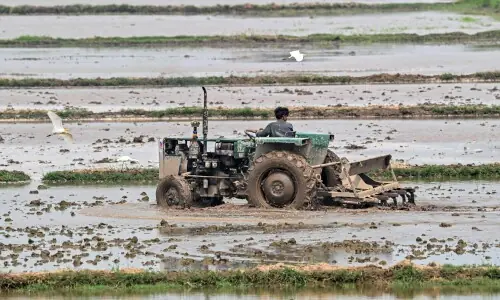
THE narrative around past natural disasters in Pakistan has rightly focused on their unfortunate scale and our lack of collective control. The horrific floods this year feel entirely familiar, and at the same time, entirely different.
We do partially accept the lack of collective control over such natural disasters. However, we are also aware that this disaster can be traced to those human activities that evidently led to climate change in the first place. This may represent our collective lack of control as Pakistanis since the country has contributed very little to the world’s vast carbon emissions. At the same time, it is certainly not a lack of collective control on the part of all humanity.
With the acknowledgement of collective control across the world, one naturally expects a global willingness to take responsibility. While the outpouring of international support for Pakistan during these tough times is heartening, one can’t help but ask a few fundamental questions about the world response we have witnessed lately.
If our collective responsibility as humans is so clear in this case, why is providing support to Pakistan voluntary and ad hoc? Why is providing this support left to the conscience of individuals and countries when we can clearly assign responsibility for climate change?
The science behind climate change helps us assign responsibility.
If these questions sound too hypothetical, let us take a crude example to illustrate the point. Let’s say that your neighbour has a car accident where no other person was to blame.
In this case, it would make sense to help with his medical expenses out of the goodness of one’s heart. But if your vehicle damages the neighbour’s car and you are primarily to blame for the accident, would it make any sense if you only reimbursed him for his medical expenses only if you felt like it? That would be unjust.
Voluntary, ad hoc global support for the recent floods in Pakistan would only make sense if human beings were not responsible for the crisis. Overwhelming scientific evidence, however, shows that they are indeed responsible for the devastation in Pakistan. Global support to Pakistan in this case should hence be mandatory and proportionate to responsibility. It should, at the very least, cover the destruction wreaked on the country.
One can understand the voluntary nature of the global response to the 2005 earthquake in Pakistan. As devastating as the 2005 disaster was, other countries weren’t responsible for it. The voluntary and ad hoc, rather than structured and mandatory, response to the floods this year, is much harder to digest.
Part of the problem is that climate change isn’t as ‘visible’, as for instance, the car accident is in our example. The solid science behind climate change helps us assign responsibility. But the complex chain of responsibility where historic levels of carbon emissions impact environmental outcomes today is much harder to ‘observe’. The global narrative today reflects this dichotomy where the science may be clear, but individual responsibility is much harder for us to see intuitively.
Fortunately, climate change activists around the world have taken Pakistan’s floods as an opportunity to shift the narrative more towards a collective responsibility. The disaster has at the very least initiated a global discussion, even though in practice, the international response remains voluntary and ad hoc. At the same time, it will be a long battle to change the global narrative and eventually the nature of response to climate change-related disasters.
Sadly, with climate change, Pakistan won’t be the first country to experience such a disaster. The floods in our country are unfortunately only a preview of what lies ahead. An increased frequency of extreme weather events is just one of the many consequences of climate change. For instance, rising sea levels threaten the lives and livelihoods of millions living in coastal areas. Global warming is likely to exacerbate water shortages in water-stressed regions globally. A warmer planet will lead to higher rates of animal extinction which will have consequences for the global ecosystem and food supply.
This makes it even more important for the world to take up the question of collective responsibility sooner rather than later. The current work on climate change mitigation and adaptation across the world is, of course, important. But it also needs to be coupled with a change in our narrative on assigning responsibility. And with that, responsibility would naturally come as mandatory and structured, and a proportional support for countries that bear the brunt of an increasingly warm planet.
The author has a doctorate from the University of Oxford and is graduate of the Harvard Kennedy School of Government
Twitter: @KhudadadChattha
Published in Dawn, October 11th, 2022