Hazara women protest ‘genocide’ as Kabul blast toll touches 35


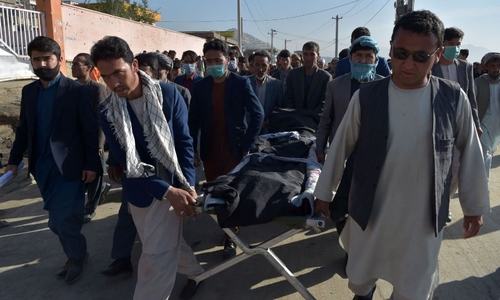
KABUL: The death toll of a suicide bombing on a Kabul classroom has risen to 35, the UN said on Saturday, as Shia Hazara women who bore the brunt of the attack staged a defiant protest against the “genocide” of their community.
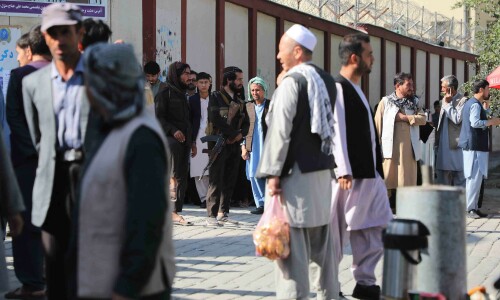
On Friday, a suicide attacker blew himself up in women’s section of Kaaj Higher Educational Centre, as hundreds of pupils were taking tests in preparation for university entrance exams in the city’s Dasht-i-Barchi area.
No group has claimed responsibility for the latest attack. The militant Islamic State (IS) group, which regards Shia as heretics, has previously claimed attacks in the area targeting girls, schools and mosques.
The western neighbourhood is a predominantly Shia Hazara enclave.
Attack shows Taliban’s failure to protect Afghan people, says Amnesty International
“The latest casualty figures from the attack number at least 35 fatalities, with an additional 82 wounded,” the United Nations Assistance Mission in Afghanistan (UNAMA) said.
Since returning to power last August, security has been a sensitive topic for the Taliban and the hardliners have often been keen to downplay attacks challenging their regime.
On Saturday, dozens of Hazara women defied a ban on rallies to protest the latest bloodshed in their community. Around 50 women chanted, “Stop Hazara genocide, it’s not a crime to be a Shia”, as they marched past a hospital in Dasht-i-Barchi where several victims of the attack were being treated.
Dressed in black hijabs and headscarves, the protesters carried banners that read: “Stop killing Hazaras”.
Witnesses said the suicide attacker detonated in the women’s section of the gender-segregated study hall. “Yesterday’s attack was against the Hazaras and Hazara girls,” protester Farzana Ahmadi, 19, said. “We demand a stop to this genocide. We staged the protest to demand our rights.”
Amnesty International said Friday’s attack was “a shamefaced reminder of the ineptitude and utter failure of the Taliban, as de-facto authorities, to protect the people of Afghanistan”.
Before the Taliban’s return to power last year, at least 85 people, mainly girls, were killed and about 300 were wounded when three bombs exploded near their school in Dasht-i-Barchi.
Again, no group claimed responsibility, but a year earlier IS claimed a suicide attack on an educational centre in the same area that killed 24. IS has emerged as a key security challenge for the Taliban, but officials claim their forces have defeated the jihadists.
Published in Dawn, October 2nd, 2022