Vector-borne diseases unleashed as Sindh reports first malaria deaths


 2
2


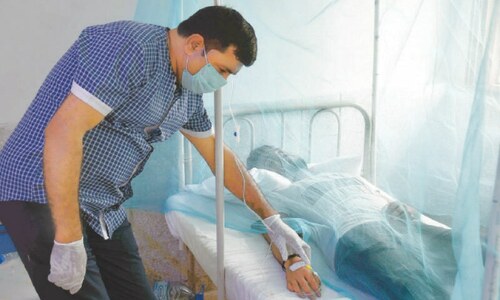
KARACHI: Exposing government’s failure in carrying out effective preventive measures to control dengue and malaria cases in Sindh, the vector-borne diseases claimed three lives on Tuesday as a woman died of dengue in Karachi while two men lost their lives in Sukkur just a few days after they had been diagnosed with malaria.
The two malaria deaths are the first reported casualties reported in Sindh from the vector-borne disease.
Health experts feared that the situation was becoming more and more challenging with each passing day in the absence of an effective preventive strategy by the health authorities.
In Karachi’s Central District, a woman died of dengue virus, who was suffering from dengue fever for the past one week and being treated at a private hospital in North Nazimabad, an official said.
Dengue claims woman’s life in Karachi
Similarly, he added that two men died at Ghulam Muhammad Mahar Medical University Hospital in Sukkur where they were being treated for malaria.
The situation was fast deteriorating as reflected in official data shared by the Sindh health department.
After the latest deaths, a total of 33 people have lost their lives in Karachi alone due to dengue this year.
254 test dengue positive in city
The data compiled and shared by the Sindh health department said on Tuesday that 254 more people tested positive for the dengue fever in Karachi during last 24 hours.
However, the authenticity of the official data is seriously questioned by independent health experts who believe that the numbers are greater than the official statistics.
In September, Sindh has recorded a total of 7,452 cases of dengue so far.
The number of malaria patients, on the other hand, has also witnessed an alarming surge mainly in rural parts of Sindh, where the post-flood situation has brought new challenges for flood victims and the provincial administration.
During the past 24 hours, Sindh recorded two deaths due to malaria and 4,583 new cases of the mosquito-borne disease.
An official said that this was the first two fatalities recorded due to malaria in Sindh this year.
While the spike in cases of dengue and malaria in the city showed no significant decline, the municipal bodies have claimed to have covered 60 to 70 per cent of the metropolis in the ongoing fumigation drives that would continue till December.
The independent experts, however, doubted the overall government efforts and called for coordinate efforts for an effective prevention strategy.
The experts say the actual number of dengue-related deaths as well as positive cases in the metropolis are also much higher.
“There’s a serious doubt over the authenticity of data being shared by the health department,” said Dr Qaiser Sajjad of the Pakistan Medical Association (PMA).
“The feedback we are getting from general physicians these days indicates that at least 15 to 20 patients are daily reporting at one clinic. This suggests that the extent of unreported cases is too large. Secondly, compiling and disseminating the data isn’t enough. We can’t handle this challenge without prevention strategy. And for that strategy, we need an effective fumigation campaign. Unfortunately, this isn’t happening in Karachi.”
He said the scale of challenge was huge and required coordinated exercise by the government to handle the situation.
Calling for a joint initiative, he suggested that the Sindh government take infectious disease experts, entomologists and officials of the Pakistan Meteorological Department and the Karachi Metropolitan Corporation on board to design an effective fumigation drive across the city.
Published in Dawn, September 28th, 2022