The great wave


“You don’t believe the sky is falling until a chunk of it falls on you ….”
It is said art and literature are timeless. Be it a modern quote from feminist writer Margaret Atwood (above), or a haiku from the 17th-century Japanese master Bashō, these literary and artistic inspirations are relatable by humankind in different cultures and geographies, as well as across the centuries.
One of the most iconic artistic images from Japan is thought to be the 19th-century woodblock print by Katsushika Hokusai titled Under the Wave off Kanagawa (also known as The Great Wave). Hokusai’s masterpiece depicts a giant rogue wave, suspiciously akin to a tsunami, engulfing three fishing boats in a storm-tossed sea, with Mount Fuji in the background.
The terrified fishermen desperately cling to their boats, with the towering wave’s outstretched and menacing ‘claws’ threatening not just the fishing boats but sacred Mt Fuji itself in the distance. The image of the giant wave threatening to devour everything in its path, yet paused in time and space, encapsulated in ‘arrested movement’, is a timeless masterpiece. While Hokusai’s woodblock print was part of a series depicting Mt Fuji, it came to contextualise a time of great uncertainty for Japan.
Unprecedented inflation and floods on a biblical scale have buffeted an already fragile polity.
The scene depicted in Hokusai’s masterpiece was not the first or last time a weather-related event came to define a historical epoch. Closer to home, both in time and geography, the devastating cyclone of 1970 in then East Pakistan was a defining moment in history too. The unimaginable destruction caused by the cyclone, and the perceived apathy of West Pakistan, is believed by historians to have been the final nail in the coffin of a united Pakistan.
If there was one iconic image capturing ‘the moment’ in contemporary Pakistan, one wonders what it would be. Millions left adrift in the aftermath of the floods? People protesting their electricity bills amidst absent power? A middle-class housewife on the brink of despair while tearfully narrating how she is unable to make ends meet?
Floods are not new in Pakistan; even the ‘biblical’ ones, it now seems. Nonetheless, the scale of destruction caused by the current disaster is truly staggering.
More pertinently, on this occasion, the floods have come at a time of crushing inflation, domestic polarisation and high discontent at the political shenanigans of a disinterested elite.
From Dhamial to Karachi, people are angry and protesting — and the anger is palpable and rising. They are protesting against their marginalisation, their electricity bills, the cost of living, the apathy of the official machinery to the flood victims. From modest living rooms in urban centres to the backwaters of Sindh, a mass of people appears to have had enough.
Will this prove to be our ‘let them eat cake’ moment? A jaded, cynical view would be that the country has witnessed many such ‘moments’ in the past, without posing any challenge to an established, toxic political order.
Read: Climate catastrophe
While natural disasters past and present, such as the 2005 earthquake or the 2010 floods, have repeatedly exposed our governance failures — not just in terms of planning, implementation or building capacity and resilience, or in domestic resource mobilisation — the 2022 version is appearing to be more man-made than natural. It is also brutally exposing to the dispossessed, disenfranchised and marginalised something much more foundational: that they have been saddled with a self-interested, self-absorbed elite that just couldn’t care less.
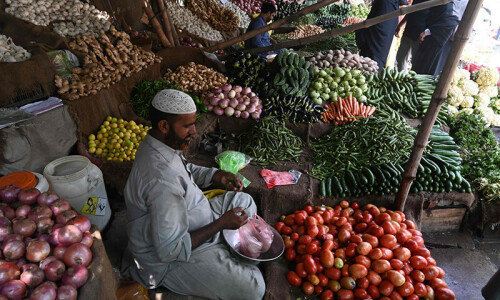
They are witnessing this not just in the response to the floods, but also in the ease with which a political class and their backers have passed the crushing ‘burden of adjustment’ under IMF conditionality on to the poor. A large part of the pent-up anger and frustration is coming from the surging cost of living. Inflation has swelled to never-before levels, with inflation for lower-income households, as depicted by the food-weighted Sensitive Price Indicator (SPI), spiking to an unprecedented 45.5 per cent as of Sept 1.
While inflation over the past few years has received impetus from a confluence of factors, including exogenous ones, the recent momentum post-April has come mainly from steep increases in administered prices of petrol, diesel and electricity tariffs.
As the masses are being impoverished and the middle class decimated due to the surging cost of living, the insulated and comfortably numb elites have celebrated the taking of ‘difficult’ decisions to secure an IMF deal.
Unsurprisingly, the impact of the measures taken is very different for the haves and the have-nots. The elite worry about whether the next vacation abroad should be in the UK or closer to home, such as Turkey or Dubai, given the rising cost of travel. The poor and the vulnerable worry about hunger, the cost of schooling, their inability to afford life-saving medicines.
The saddest part is that while inflation may abate, its after-effects for vulnerable households may be anything but transitory. High inflation for protracted periods can push borderline households into inter-generational poverty.
While the floods may end up thrusting into poverty many of the upwards of 30 million (mostly rural) people affected, food inflation at current levels has been estimated by the Asian Development Bank to impoverish over 25m people. Even after accounting for the overlap, the numbers are staggering.
As in the case of a tsunami, we are being buffeted by the first waves of disaster. Mass migration into cities of the hungry and dispossessed flood-affected people will follow, coupled with food shortages and the attendant second wave of inflation. At the same time, the economy will be groaning under the weight of stabilisation policies, unable to create jobs — or stop joblessness. The perfect storm will only unleash further waves of discontent.
It is unlikely that impoverishment and discontent on the scale we will witness will fail to produce over time a tectonic shift in Pakistan’s political landscape. Like the fishermen in Hokusai’s masterpiece, we can only gape in terrified suspense at the great wave before us.
The writer is a former member of the prime minister’s economic advisory council, and heads a macroeconomic consultancy based in Islamabad.
Published in Dawn, September 15th, 2022