• Health ministry proposed increase in prices of 10 medicines under ‘hardship cases’
• Drugs include prescriptions for women’s fertility, malaria, hypoglycaemia and anaesthetics
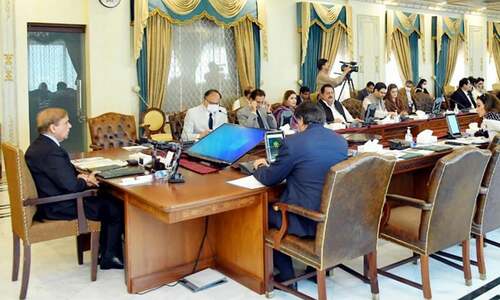
ISLAMABAD: Prime Minister Shehbaz Sharif on Tuesday vetoed another proposal seeking an increase in the prices of 10 medicines up to 25 per cent, saying he cannot support such a move.
However, a senior official of the Ministry of National Health Services (NHS), wishing not to be named, said the majority of the medicines whose prices were sought to be raised were meant for rare diseases, while one was included on the directions of the Sindh High Court.
Earlier on Aug 16 as well, the federal cabinet had rejected a summary presented by the NHS Ministry suggesting an increase in the prices of 35 medicines, and stated that the price of no medicine would be increased in the future without the approval of the cabinet.
According to the agenda of Tuesday’s meeting of the cabinet, the ministry proposed an increase in prices of 10 medicines under hardship cases.
It is worth mentioning that if the production of a medicine becomes unviable due to an increase in the cost of raw material, the ministry could move cases under the hardship category to allow the manufacturing companies to increase the maximum retail price and ensure availability of the drugs in the market.
However, the prime minister instantly said he could not support any move to increase the prices of medicines. Following the premier’s stance, the entire cabinet decided to reject the proposal.
A statement was even issued from the office of Health Minister Abdul Qadir Patel that he also rejected the proposal.
According to a ministry official, the majority of the medicines on the agenda were meant for rare issues such as women’s fertility, anti-malaria, anaesthesia, etc.
“One of the medicines/solutions was meant for hypoglycemia and its price is just Rs2, so the company refused to continue its production due to unviability at such a low cost. We had suggested increasing the price by around 25pc but even that case was rejected,” the official said.
Hypoglycemia occurs when the blood sugar (glucose) level falls too low for bodily functions to continue.
“The case of one of the medicines on the list was received from the Sindh High Court, as a pharmaceutical company had approached it seeking a price increase. We included the medicine, meant for heart patients, to the list but all of them were rejected by the cabinet,” he added.
Earlier, the Pakistan Pharmaceutical Manufacturers Association (PPMA) had deplored the cabinet’s Aug 16 decision that it said would result in complete unavailability of the medicines, which were being sold at lower rates than the cost of their production. These drugs were registered in the 1970s and 80s when the dollar exchange rate was very low.
“As the dollar exchange rate was very low at that time, low prices were fixed, and till now the medicines were being sold at Re1 and Rs2 per tablet. Similarly, the medicines meant for cancer patients are also being sold at low rates. Since the companies cannot sell them for more than the maximum retail price (MRP), their cost of production is exceeding the MRP, making it unviable for the companies to continue manufacturing the medicines,” association representative Mr Hamid Raza had told Dawn back then.
Meanwhile, ministry spokesperson Sajid Shah told Dawn that on the directions of Health Minister Patel, a crackdown has been launched on spurious and unregistered medicines across the country.
He said during a raid in Peshawar, unregistered medicines worth Rs35 million were recovered and 25 stores sealed.
“Similarly, teams of the Drug Regulatory Authority of Pakistan have been raiding medical stores in Islamabad, Rawalpindi, Lahore and other cities,” Mr Shah added.
Health Minister Patel had on Monday announced a crackdown on spurious and unregistered medicines.
Published in Dawn, September 14th, 2022