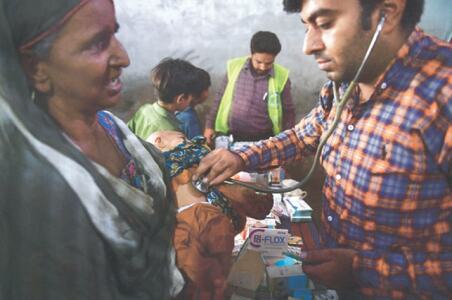
Women, girls most vulnerable following catastrophic floods: US envoy


ISLAMABAD: Just as the Covid-19 pandemic highlighted the disproportionate impact on women’s participation in workforce, the catastrophic flooding in Pakistan was a reminder that women and girls were among the most vulnerable groups during the humanitarian crisis.
This was pointed out by American Ambassador to Pakistan Donald Blome while speaking at the launch of the Pakistan Future of Women and Work Initiative on Tuesday.
The event was organised by the US embassy in partnership with Texas A&M University, S&P Global, the US-Pakistan Business Council as well as the US Pakistan Women’s Council (USPWC).
Mr Blome said while the United States worked to provide direct assistance to affected communities in Pakistan and help mitigate the effects of future floods, it would closely consider the unique impacts of the current flooding and other natural disasters on women and girls.
He highlighted that the US provided $53.1 million in humanitarian assistance to support Pakistan in the wake of the recent floods.
The launch event brought to the fore a study on the impact of Covid-19 on women’s workforce participation in the country. It aimed to catalyse research, public discourse and private sector commitments to address gaps facing women amidst the pandemic.
Speaking on the occasion, the State Department’s Acting Principal Deputy Assistant Secretary for South and Central Asian Affairs Elizabeth Horst said: “Through the US-Pakistan Women’s Council, the US has been working for a decade to build bridges between peoples of the two countries to support Pakistan’s sustained prosperity, benefiting thousands of women in Pakistan. Today’s initiative will help create a foundation for greater collaboration and exchange between our two countries on women’s economic advancement.”
Dr Raymond Robertson, lead author of the study and director of the Mosbacher Institute for Trade, Economics and Public Policy at Texas A&M University’s Bush School said: “Women the world over bore a larger burden during the Covid-19 crisis than they usually do during economic recessions. Pakistan was no exception. We intend for our findings to start a conversation and shape investments to help women in the economy thrive.”
Published in Dawn, September 14th, 2022