3
3


A VISIBLY panicked herdsman moves fast to reach a safer place with his herd — a vital economic asset for the rural population. Inhabitants of several villages located in Sehwan taluka and in Bhan Syedabad are on the move.
Since Wednesday night, almost the entire strip of the Larkana-Sehwan (LS) bund’s metal road was flooded with people carrying their cattle and livestock besides families in all sorts of vehicles. A mass exodus was evident.
Many villagers with charpoys, livestock and fodder, stocked grain, motorbikes and other belongings they could save shifted to the LS bund — a relatively safe elevated surface.
“For God’s sake, arrange us two [tractor] trolleys so that we can shift from here. Nobody listens. I called Sikandar Rahupoto, my elected representative, but in vain,” implored an elderly Niaz Hussain near Haji Qasim Leghari village in UC Talti while talking to Dawn along with fellow villagers. He was worried that snakes were appearing near the bank.
Villagers were also busy building a ring dyke around Karampur, a small city in Sehwan taluka. The LS dyke road bifurcates floodplains of the mighty Indus and Sehwan taluka of Jamshoro, and leads to various areas like Sehwan’s union councils of Talti, Bhan Syedabad and then Dadu city. The dyke marks the zero point of the Indus Link. Locals said the quantum of flows from the two cuts of Manchhar Lake and the breach at RD-10 of Main Nara Valley Drain (MNVD) had started reaching Bhan Syedabad after flowing near Talti, Bhanbha and Kot Lashari.
A flooded Sehwan toll plaza could be seen from a couple of kilometres. “I had placed this stone there to mark the speed of water approaching the Indus Highway. When this stone was submerged in a short span of time, I put it here to see how fast water is travelling on the highway,” said motorway policeman Sajid Shah, deployed at N-55 to prevent people from going towards the highway.
Cattle and livestock owners were reaching or crossing the Indus Highway from different directions. “I had left Talti union council this morning and am heading for Sehwan,” Ameer Ali, one such traveller, replied curtly at 1pm. He was followed by people with their herds.
“Now Bhan Syedabad will sink,” said a frantic young man while crossing my vehicle. Reports of gushing waters approaching Bhan Syedabad sent shivers down villagers’ spine. Such flows were reaching the area from two ‘relief cuts’ given at RD-14 and RD-52 of Manchhar Lake on Sept 4 morning and Sept 5 evening, respectively to offload it.
The villagers first shifted to the narrow road of LS bund. Those with resources were arranging logistics to move along the Indus Highway so they could find some fodder for their animals.
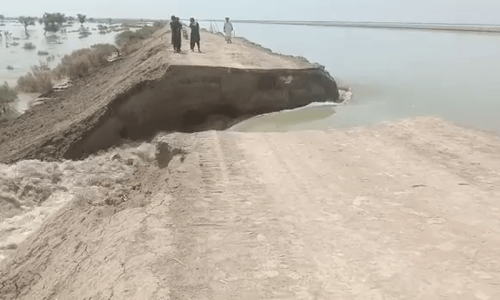
“If irrigation authorities didn’t give a controlled cut to LS bund, we will do it on our own to avoid being drowned,” reacted an angry Nadeem Buledi near the Indus link that marked its zero point.
Villagers were trying their best to protect Karampur from the water travelling from Manchhar’s cuts and MNVD’s breach by strengthening a private dyke. They were using soil from the right bank of RBOD-II with the help of the irrigation department. The lake’s Danister regulator located on LS bund was releasing water from the lake. The quantum of the entire flow from the lake’s two cuts and MNVD’s breach has to finally go into the Indus, provided the river’s level remains lower than the water collected near the Indus Link.
A ‘controlled cut’ at a section of LS bund is the recourse available to the officials and government. The site where the dyke would be cut would be at least a couple of kilometres away from the Danister regulator to keep it out of harm’s way, admitted an official.
For a few days, the irrigation officials were awaiting the Indus flows to fall at a point upstream Kotri barrage where Manchhar and MNVD’s flows were to be released by a ‘controlled cut’ in the LS dyke.
The irrigation authorities didn’t want to take things lying down considering the enormity of the crisis. “The water level is to be gauged through an instrument instead of doing anything in haste. Any miscalculation can backfire,” conceded a senior official.
Large swathes of the area already remained under water. The area where a cut was to be given was part of the chief minister’s constituency.
The Sindh irrigation minister, Jam Khan Shoro, also felt a cut in LS bund would become the last resort but can’t be made in a hurry. Once safer levels of Indus were determined, the cut could be made to let the accumulating flows of Manchhar and MNVD enter the river.
Machines were mobilised to the site around 3,000 to 4,000 feet from the Danister regulator at the bund at the time of going to print.
Published in Dawn, September 9th, 2022