12 killed in Baghdad clashes as Moqtada Sadr loyalists storm complex


BAGHDAD: Twelve protesters were killed on Monday after powerful cleric Moqtada al Sadr said he would quit politics, prompting his loyalists to storm a palatial government complex in Baghdad and leading to clashes with rival Shia groups.
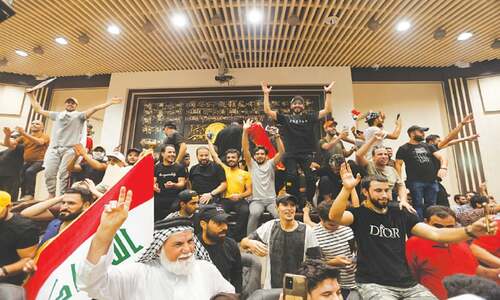
Young men loyal to Sadr charged the government headquarters in Baghdad’s Green Zone, once a palace of Saddam Hussein, and took to the streets outside the area where they skirmished with supporters of rival Tehran-backed groups.
As gunfire echoed over the capital, some people were seen firing guns towards the ranks of supporters of Sadr, while others fired into the air in a nation awash with weapons after years of conflict and unrest. Supporters of rival groups also hurled rocks at each other.
The flare-up followed a political deadlock lasting months that has blocked the formation of a new cabinet. The army swiftly ordered a curfew.
Curfew imposed across Iraq; Sadr says will ‘quit politics’; UN calls development extremely dangerous, urges protesters to leave the area immediately
“I hereby announce my final withdrawal,” Moqtada Sadr had announced earlier on Twitter, criticising fellow Shia political leaders for failing to heed his calls for reform.
The clashes erupted hours after that declaration, prompting his supporters, who had already been staging a weeks-long sit-in at parliament in the Green Zone, to demonstrate and storm the main cabinet headquarters. Some jumped into a swimming pool at the palace, cheering and waving flags.
Calling the developments “an extremely dangerous escalation”, the United Nations Assistance Mission in Iraq (UNAMI) urged “protesters to immediately leave” the area. It urged “all” to “refrain from acts that could lead to an unstoppable chain of events”.
Iraq’s military declared an open-ended nationwide curfew and urged the protesters to leave the Green Zone.
During the stalemate over forming a new government, Sadr has galvanised his legions of backers, throwing into disarray Iraq’s effort to recover from decades of conflict and sanctions and its bid to tackle sectarian strife and rampant corruption.
Sadr, who has drawn broad support by opposing both US and Iranian influence on Iraqi politics, was the biggest winner from an October election, but withdrew all his lawmakers from parliament in June after he failed to form a government that excluded his rivals, mostly Tehran-backed parties.
Sadr has insisted on early elections and the dissolution of parliament. He says no politician who has been in power since the US invasion in 2003 can hold office.
In Monday’s announcement, Sadr said he would close his offices, although he said cultural and religious institutions would remain open.
Sadr’s decision ramped up dangerous tensions among heavily armed groups. Many Iraqis worry that moves by each camp could lead to a new civil conflict.
“The (Iran) loyalists came and burned the tents of Sadrists, and attacked protesters,” said Kadhim Haitham, a supporter of Sadr.
Pro-Iran groups blamed the Sadrists for the clashes and denied having shot at anyone. “It’s not true — if our people had guns why would they need to throw rocks?” said one militia member.
Sadr has withdrawn from politics and the government in the past and has also disbanded militias loyal to him. But he retains widespread influence over state institutions and controls a paramilitary group with thousands of members.
He has often returned to political activity after similar announcements, although the current deadlock in Iraq appears harder to resolve than previous periods of dysfunction.
The current impasse between Sadr and rivals has given Iraq its longest run without a government.
Sadr’s ally Mustafa al Kadhimi, who remains caretaker prime minister, suspended cabinet meetings until further notice after protesters stormed the government headquarters.
Iraq has struggled to recover since the defeat of the militant Islamic State group in 2017 because political parties have squabbled over power and the vast oil wealth possessed by Iraq, Opec’s second-largest producer.
Published in Dawn, August 30th, 2022