UN court rejects Myanmar’s pleas, rules genocide case can go ahead



THE HAGUE: The UN’s highest court ruled on Friday that a landmark case accusing the Myanmar government of genocide against Rohingya Muslims can go ahead.
The International Court of Justice (ICJ) in The Hague threw out all of Myanmar’s objections to a case filed by the west African nation of Gambia in 2019.
The decision paves the way for full hearings at the court on allegations over majority-Buddhist Myanmar’s bloody 2017 crackdown on the Rohingya.
Joan Donoghue, the ICJ president, said the tribunal “finds that it has jurisdiction... to entertain the application filed by the Gambia, and that the said application is admissible”.
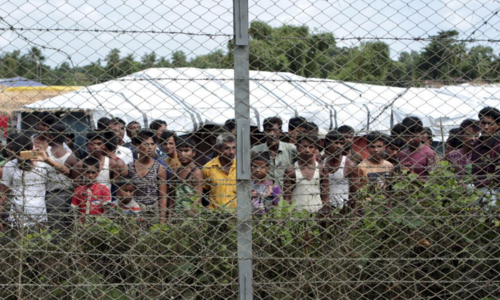
Hundreds of thousands of Rohingya fled the south-east Asian country during the operation five years ago, bringing with them harrowing reports of murder, rape and arson.
Around 850,000 Rohingya are languishing in camps in Bangladesh while another 600,000 Rohingya remain in Myanmar’s south-western Rakhine state.
Myanmar was originally represented at the ICJ by Nobel laureate Aung San Suu Kyi, but she
was ousted as civilian leader in a coup last year and is now in detention.
Mainly-Muslim Gambia filed the case in November 2019 alleging that Myanmar’s treatment of the Rohingya breached the 1948 UN Genocide Convention.
Myanmar’s arguments rejected
Myanmar had argued on several grounds that the court had no jurisdiction in the matter, and should dismiss the case while it is still in its preliminary stages.
But judges unanimously rejected Myanmar’s argument that Gambia was acting as a “proxy” of the 57-nation Organisation of Islamic Cooperation in the case.
Only states, and not organisations, are allowed to file cases at the ICJ, which has ruled on disputes between countries since just after World War II.
They also unanimously dismissed Myanmar’s assertions that Gambia could not file the case because it was not a direct party to the alleged genocide, and that Myanmar had opted out of a relevant part of the genocide convention.
Finally they threw out by 15-1 Myanmar’s claim that there was no formal dispute at the time Gambia filed the case, and that the court therefore had no jurisdiction.
It could take years for full hearings and a final judgement in the case.
US Secretary of State Antony Blinken declared in March that the Myanmar military’s violence against the Rohingya amounted to genocide.
The International Criminal Court, a war crimes tribunal based in The Hague, has also launched an investigation into the violence against the Rohingya.
Published in Dawn, July 23rd, 2022