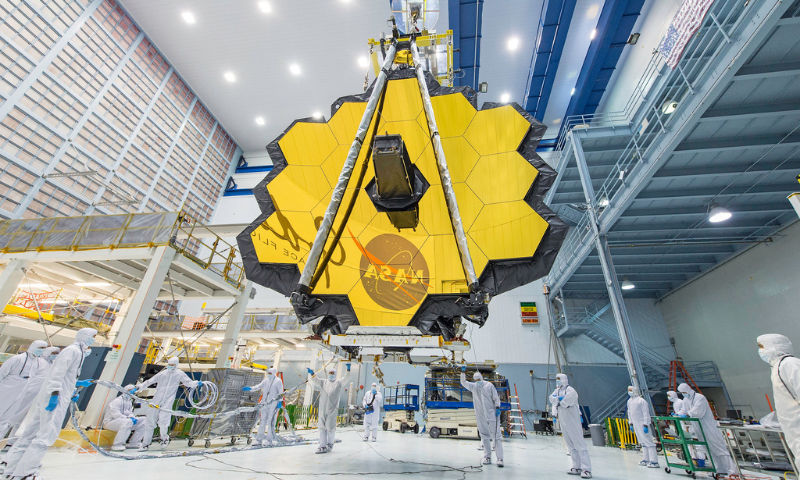
Nasa reveals James Webb Space Telescope’s first cosmic targets


WASHINGTON: The US National Aeronautics and Space Administration (Nasa) said on Friday the first cosmic images from the James Webb Space Telescope would include unprecedented views of distant galaxies, bright nebulae and a faraway giant gas planet.
The US, European and Canadian space agencies are gearing up for a big revelation on July 12 of early observations by the $10 billion observatory that is set to give new insights into the origins of the universe.
“I’m looking very much forward to not having to keep these secrets anymore, that will be a great relief,” Klaus Pontoppidan, an astronomer at the Space Telescope Science Institute (STSI) that oversees Webb, said last week.
An international committee decided the first wave of full-colour scientific images would include the Carina Nebula, an enormous cloud of dust and gas 7,600 light years away, as well as the Southern Ring Nebula, which surrounds a dying star 2,000 light years away.
Carina Nebula is famous for its towering pillars that include “Mystic Mountain”, a three-light-year-tall cosmic pinnacle captured in an iconic image by Hubble.
Webb has also carried out a spectroscopy _ an analysis of light that reveals detailed information _ on a faraway gas giant called WASP-96 b, which was discovered in 2014.
Nearly 1,150 light years from Earth, WASP-96 b is about half the mass of Jupiter and zips around its star in just 3.4 days.
Next comes Stephan’s Quintet, a compact galaxy 290 million light years away. Four of the five galaxies within the quintet are “locked in a cosmic dance of repeated close encounters”, Nasa said.
Finally, and perhaps most enticing of all, Webb has gathered an image using foreground galaxy clusters called SMACS 0723 as a kind of cosmic magnifying glass for extremely distant and faint galaxies behind it.
This is known as “gravitational lensing” and uses the mass of foreground galaxies to bend the light of objects behind them, much like a pair of glasses.
Dan Coe, an astronomer at STSI, said even in its first images, the telescope had broken scientific ground.
Published in Dawn, July 9th, 2022