10
10

The National Command and Operation Centre (NCOC) on Tuesday issued new guidelines for prayers and qurbani — with masking up and social distancing among the measures — on Eidul Azha to curb the resurgent Covid-19 in the country.
Pakistan has seen a spike in coronavirus cases since June, primarily attributed to the new BA.5 sub-variant of Omicron. After months of near normalcy, the new guidelines harken back to the time of the early waves of Covid.
According to the National Institute of Health (NIH), the country reported 653 new infections in the last 24 hours, while the positivity rate clocked in at 3.45 per cent.
No new deaths have been reported during this time.
In the last 24 hours, 18,950 tests were conducted and 162 patients were in critical care.
Health experts have warned that Covid cases could surge during the upcoming festivities if people don't exercise caution.
In a notification today, the NCOC noted that Eidul Azha will be observed on July 10. "Being a significant religious event/congregation; Eidul Azha prayer and qurbani assume greater importance under the current Covid situation in the country," it said, subsequently announcing a number of guidelines.
Per the advice, Eid prayers will be organised in open spaces "under stringent Covid protocols".
In case of a compulsion to offer prayers inside mosques, all the doors and windows should remain open for ventilation.
It also recommended that two to three prayers be organised at one venue with staggered timings so that maximum people can attend it with Covid precautions.
"All ulemas leading the Eid prayers should be sensitised to keep sermons short so that people don't have to stay in closed spaces for a longer period of time," it added.
The elderly, sick and young children have been discouraged from attending congregation because they are more vulnerable to getting infected.
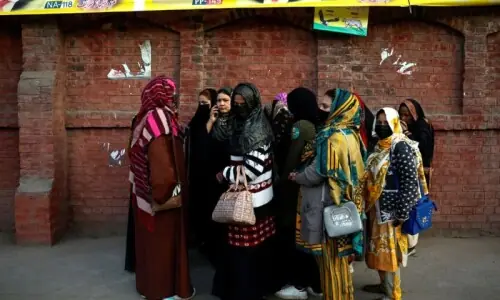
Meanwhile, no one will be allowed to enter mosques without masks. There will separate entry and exit points at the venue to avoid "jumbling up of individuals" and hand sanitiser dispensers will be installed.
The NCOC has further instructed mosques to ensure social distancing of at least six feet between worshippers to avoid physical contact. People should also refrain from shaking hands or hugging each other to avoid the chances of disease transmission, it added.
Separately, people have been encouraged perform ablution at home and bring their own prayer mats to the mosques.
In addition, gathering after the prayers have been discouraged and people have been advised to immediately disperse after the congregation.
SOPs for qurbani
Furthermore, the government has encouraged people to opt for collective qurbani this year through public, private and community organisations and ensure the implementation of precautionary measures.
For this purpose, ulema and religious scholars have also been told to encourage people for collective and "online qurbani".
Meanwhile, provinces will be initiating awareness campaigns to educate the masses on the spread of the virus during meat distribution.
The NCOC said that the site of slaughtering should be at a distance from residential areas and be a vast open space. Crowding at the site should be avoided and only a limited number of people would be allowed.
No entry inside cattle markets without masks
Earlier today, Punjab Health Secretary Ali Jan Khan said that entry inside cattle markets across the province won't be allowed to people not wearing masks.
He instructed markets' management to provide masks and sanitisers to sellers and buyers.
Separately, Jan stressed: "All the residents will be compelled to wear masks at public gatherings, public transport, and offices. Social distancing has also been made compulsory."
The official also said that Covid vaccination for children over 11 years was mandatory.