0
0

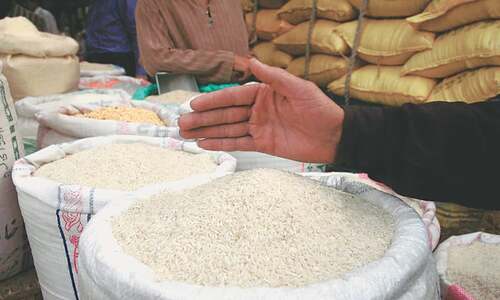
ISLAMABAD: The intensification of demand for rice from all regions of the world, except Asia, is expected to benefit Pakistan to register strong rebounds in 2022, the Food and Agriculture Organisation (FAO) of the United Nations says in its report on ‘World Food Outlook’.
The international trade in rice is anticipated to expand for the third consecutive year in 2022, with volumes exchanged across the world forecast at 53.1 million tonnes — three per cent higher than the 2021 peak.
The report says this may benefit shipments from Brazil, China, Pakistan, Uruguay and especially Thailand. India is predicted to remain the world’s largest rice exporter, report says.
In Pakistan, the record high output of rice stood at 9.323 million tonnes during 2020-21 — higher by 10.7 per cent than previous year’s production of 8.420 million tonnes. Official statistics showed that from the last couple of years, area under rice cultivation is witnessing a rising trend. As domestic rice production exceeds domestic annual requirement, the country often has exportable surplus.
Country produced 9.3m tonnes of rice in 2020-21 against 8.4m tonnes in 2019-20
FAO’s biannual report, released last week, says total rice utilisation in 2022-23 is pegged at 522 million tonnes, only slightly above the 2021-22 high, as another sturdy expansion in food intake is forecast to be mostly outweighed by declines in non-food uses. To meet this forecast volume of use, global rice inventories would need to be drawn down, albeit by a small volume of 0.8 million tonnes.
This would place world rice stocks at 191.6 million tonnes, their second highest level on record, largely due to accumulations in China (mainland) and India. International rice prices have risen steadily since the beginning of 2022 amid strong import demand and supply constraints in the Japonica and fragrant segments.
The 2022 season is by now well-advanced south of the equator, where harvests of the first or sole crop of the season have wrapped up, while in the northern hemisphere, sowings of 2022 crops have just begun. Although much will depend on weather patterns, especially in the context of the lingering La Niña conditions, FAO pegs its preliminary forecast for world rice production in 2022 at 519.5 million tonnes (milled basis), implying a minor (1.4 million tonnes) fall from the 2021 record-high and the second largest harvest on record.
Asia, the world’s rice bowl, is expected to sustain this generally positive result. Prospects for the region are bolstered by forecasts of generally normal monsoon rains. In addition, although hikes in the prices of alternate crops are exposing the sector to more intense competition for land this season, Asian paddy plantings are seen as remaining largely unscathed as the strategic role of rice in food security provides the sector with strong government assistance.
Limited availabilities of water for irrigation cloud the outlook for Iraq, Iran, Pakistan, with output also seen falling in South Korea and Japan. Yet, the largest absolute Asian output contractions are forecast to take place in Sri Lanka and Myanmar, where scarce and inaccessible inputs, on the backdrop of broader economic constraints, weigh heavily on production prospects this year.
According to the outlook, world rice utilisation has expanded at an accelerated annual rate of close to two per cent since 2020-21, as expansions in state assistance programmes are helping vulnerable consumers cope with the impact of the pandemic coincided with a revival in the use of rice for animal feed. Early expectations for the 2022-23 season, however, point to a somewhat altered rice consumption landscape. Total rice utilisation is forecast to exceed its 2021-22 record volume by a small margin of 0.2 per cent (1.0 million tonnes) to reach 522.0m tonnes (milled basis).
The report says that global food import bill is on course to hit a new record of $1.8 trillion this year, but higher prices and transport costs rather than volumes account for the bulk of the expected increase. The global food import bill is projected to rise by $51 billion from 2021, of which $49bn reflects higher prices. “These are alarming signs from a food security perspective, indicating that importers will find it difficult to finance rising international costs, potentially heralding an end of their resilience to higher prices,” the report notes.
Published in Dawn, June 13th, 2022