0
0
ISLAMABAD: The coalition government led by the PML-N has decided to continue the ‘Ten Billion Tree Tsunami Programme’ of the PTI government, and has earmarked Rs9.45 billion under the PSDP 2022-23.
The government is doing so to upscale the revised ‘Green Pakistan Programme’ aimed at achieving the target of planting 500 million trees.
The implementation of the Ten Billion Tree Tsunami Programme was initiated in 2019 with a total cost of Rs125.18bn for four years (2019-23) to plant and regenerate 3.296bn plants across the country.
The programme is being implemented by the provincial forest and wildlife departments through the ministry of climate change on the 50 per cent cost-sharing basis, except Azad and Jammu Kashmir and Gilgit-Baltistan which are 100pc funded by the federal government through the Public Sector Development Programme (PSDP).
According to official statistics released this week, the programme has planted 579.093m saplings till March 2022. Through this programme, 327,877 man months have been employed till March.
The Pakistan Economic Survey for 2021-22 states that the meager forest cover area due to growing population, and dependence on the natural resources coupled with deforestation have rendered the country one of the most vulnerable to climate change effects.
As a result, natural resources are under tremendous pressure owing to change of land use and habitat destruction and consumption of fuel wood and timber extraction. Such pressures have rendered most of the forests of poor and medium density in need of drastic restocking on war footing.
According to the National Forest Reference Emissions Level (FREL) findings, the country is maintaining 4.786 million-hectare (5.45 per cent) area under forest cover. Within the forest cover area, dry temperate forests hold the largest share (36pc), followed by sub-tropical broadleaved shrub (19pc), moist temperate (15pc), Chir Pine (13pc), Riverine (4pc), irrigated plantation (4pc), thorn (3pc), mangrove (3pc) and subalpine forests (2pc).
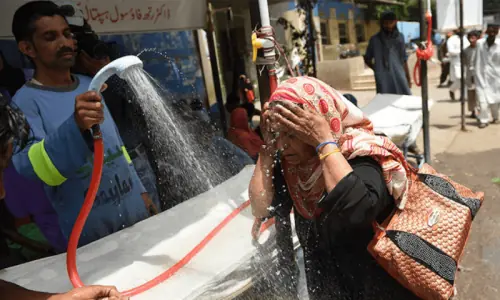
The Global Climate Risk Index 2021 ranks Pakistan as the eighth most vulnerable country susceptible to negative effects of climate change. The effects of climate change are being felt with a greater intensity with every passing year.
During 2000-19, Pakistan has lost $3.7bn annually on an average due to climate change impacts. Pakistan is also among the top five countries having the least clean air, despite having a meager contribution in global Green House Gas (GHG) emissions.
Pakistan, once a water rich country with water availability of more than 5,000 cubic metres per person per year in 1947, has become a water-stressed country with 1,000 cubic meters per capita per year, which is expected to further reduce to 860 cubic metres per person by 2025 to become the first water stressed country in South Asia.
Published in Dawn,June 12th, 2022