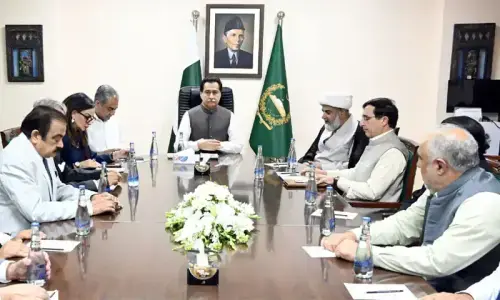
KARACHI: Describing the Malir Expressway as illegal, speakers at a seminar have demanded that the government stop the controversial project forthwith.
The whole process of its approval was a farce, they said, while bitterly criticising the government for ignoring local communities in the Malir Expressway project.
It would cause loss of livelihood to local people and damage valuable biological assets, stated the speakers at the seminar titled “An Analysis of the Environmental and Social Effects of Malir Expressway Project” organised on Wednesday by the Urban Resource Centre (URC).
Sharing their concerns over the project’s approval, they alleged that the project aimed at serving only the elite was already under construction as it had been granted a no-objection certificate by the Sindh Environmental Protection Agency (Sepa) in violation of the law concerned.
“It’s a grave violation of the Sepa law as no project could be executed without getting approval from the respective department. Besides, there was no consultation with local communities at all during the preparation of the project’s environmental impact assessment (EIA) report which had incorrect data,” said Akhtar Rasool representing the Indigenous Rights Alliance.
The flawed EIA report, which attracted a lot of concern during its presentation at a public hearing, was rejected, he added.
“The environmental watchdog neither took notice of the public outcry nor responded to the document containing reservations of experts and locals,” they said.
The area of Malir in question, he said, constituted the last remaining agricultural areas of the city and should be protected. “Instead of taking action against the several illegal housing societies that have gobbled up thousands of acres of agricultural land in Malir over the years, the government has taken up a project that entails destruction of several Malir’s villages, their rich biodiversity and ecology.”
Explaining his point further, he said the construction of the mega project would dry up wells and underground water reservoirs. Several houses would be demolished as well as an old library that was located in the project’s path.
Hafeez Baloch, also representing the alliance, said the project would only serve the elite. “It’s highly condemnable that the government has initiated this project only to facilitate real estate developers, including builders of Bahria Town and DHA City. The fact has been ignored that the whole city, which is already experiencing the impact of climate change, would pay the cost of the consequent environmental destruction.”
To a question, Mr Baloch said that while government officials had been making claims of sorts, there was no change in the project design.
Zahid Farooq of the URC emphasised the need for unity among all segments of society who were directly or indirectly affected by the so-called development projects. “We believe all groups affected either by projects or government operations pertaining to Gujjar and Orangi nullahs or Manzoor Colony should unite under one banner and launch a resistance movement.”
Published in Dawn, June 9th, 2022