Kazakhstan holds referendum to move past Nazarbayev era
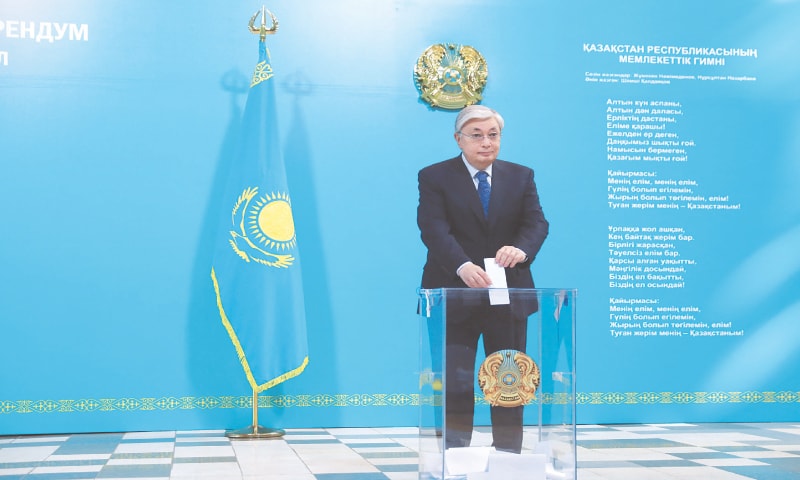

ALMATY: Polling stations closed across Kazakhstan on Sunday for a referendum to overhaul the constitution after deadly unrest ended founding leader Nursultan Nazarbayev’s three-decade grip on Central Asia’s richest country.
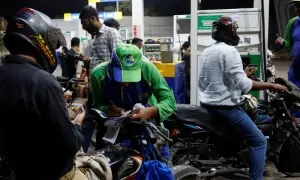
The January bloodshed — which grew out of peaceful protests over a spike in car fuel prices — left more than 230 people dead and prompted authorities to call in troops from a Russia-led security bloc.
The drive for a “New Kazakhstan” in the wake of the violence has come from the man that Nazarbayev hand-picked to replace him as president in 2019, Kassym-Jomart Tokayev.
Tokayev, 69, describes the snap referendum as a shift from “super-presidential” rule that will strengthen parliament.
But it is the absence of special privileges for 81-year-old Nazarbayev that is the most eye-catching change to the constitution.
Prior to January’s crisis, Tokayev was widely seen as ruling in the shadow of Nazarbayev and his super-rich relatives.
Even after stepping down as president, Nazarbayev retained the constitutional title of “Elbasy”, or “Leader of the Nation” — a role that afforded him influence over policymaking regardless of his formal position. The new constitution does away with that status.
Another amendment prevents relatives of the president from holding government positions — a clear nod to the influence of Nazarbayev’s family and in-laws, who lost powerful positions in the aftermath of the violence.
Polling stations in the largest city Almaty saw a slow trickle of voters in cloudless, breezy summer conditions.
Ayan, an 18-year-old student voting for the first time, said he welcomed the former president’s removal from the basic law.
“He has his place in our history textbooks, but all citizens should be equal in the constitution,” he said, after casting his vote at his university, where a small group of activists protested for the release of political prisoners and against the vote.
In the capital Nur-Sultan, named for Nazarbayev, a 46-year-old businessman called Bolat said that he did not intend to vote.
“It’s a formality to cement the position of the current leadership. The result will be the same,” he said. The constitution is almost certain to pass, and there has been no visible “no” campaign.
Voting in Almaty and Nur-Sultan concluded at 8pm local time (1400 GMT) and an hour later in the west of the vast country, with a government-endorsed pollster’s exit poll expected on Sunday night.
Kazakhstan’s New Year crisis remains poorly understood, with a days-long internet shutdown at the peak of the unrest helping to further obscure the events.
Protests stirred in the oil-producing west over a New Year fuel price hike, but it was Almaty — 2,000 kilometres away — that became the epicentre of armed clashes, looting and arson.
Nur-Sultan, which was called Astana prior to 2019, remained largely untouched.
Published in Dawn, June 6th, 2022