0
0

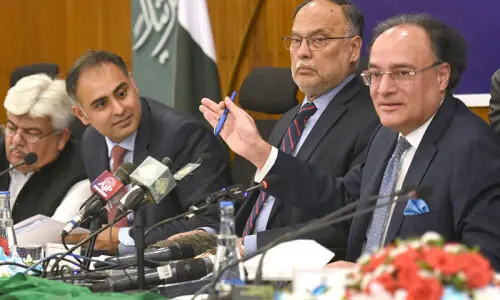
ISLAMABAD, Dec 8: Prime Minister Shaukat Aziz has called for renewing the spirit of the Saarc Charter, its principles and objectives, to create a partnership for peace, progress and prosperity in South Asia. He made this call on the occasion of the 20th anniversary of the signing of the charter of the seven-nation South Asian Association for Regional Cooperation (Saarc) that comprises Bangladesh, Bhutan, India, Maldives, Nepal, Sri Lanka and Pakistan.
The prime minister’s message was: “Let us re-position Saarc as a pragmatic, issue driven and result oriented organisation which can be a factor for peace and an engine for progress in the region by creating an enabling environment for an increase in economic activity, people to people contacts and cultural exchanges.”
The occasion holds special significance because after two decades of its existence the Saarc member states have decided to expand the regional grouping to welcome Afghanistan as a full member of the organisation, and China and Japan as observers.
The landmark decision was taken at the Dhaka Summit last month.
While there are questions about how Afghanistan, still in dire straits economically and politically, would strengthen the organisation, the association of China and Japan, two giant economic powers of Asia, promises to lend it greater vigour and dynamism.
The formal induction of Afghanistan into the Saarc fold will take place at the next Summit to be hosted by India in early 2007. The Saarc Charter will now be revisited at a special session of the standing committee in Dhaka in spring next year. The council of ministers will then decide the modalities of the new membership in its meeting in July 2006.
After years of inertia Saarc has now started moving towards fulfilling its long-professed objectives. In the last two years there have been particularly encouraging developments on the Saarc front.
Last week, Safta negotiations successfully concluded in Kathmandu, clearing the way for it to become operational from January 1, 2006.
“It (Safta) will augur well for regional cooperation and open a new era of vibrant economic collaboration within the region,” notes Ms Riffat Masood, director Saarc at the Foreign Ministry who represented Pakistan at the Safta talks in Kathmandu.