$6bn IMF deal is ‘outdated’, says Bilawal

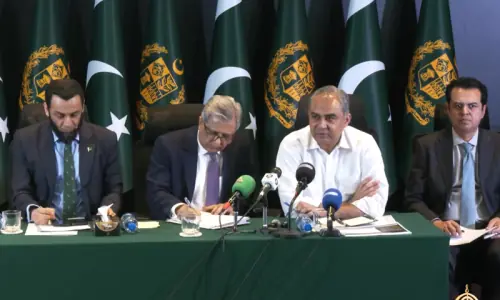
DAVOS: An ongoing bailout deal between Pakistan and the International Monetary Fund (IMF) is “outdated” given a number of global crises, Foreign Minister Bilawal Bhutto-Zardari said on Wednesday.
Pakistan entered a three-year, $6bn IMF deal in 2019, but is struggling to implement tough policy commitments. Talks are under way in the Qatari capital of Doha to release funds to stabilise Pakistan’s struggling economy.
“This IMF deal is not based on ground realities, and the context has absolutely changed from the time that this deal was negotiated,” he told Reuters on the sidelines of the World Economic Forum.
“This deal is a pre-Covid deal. It is a pre-Afghanistan fallout deal. It is a pre-Ukrainian crisis deal. It is a pre-inflation deal,” Mr Bhutto-Zardari said. Terming the deal outdated, he said it would be unfair and unrealistic to expect a developing country like Pakistan to navigate geopolitical issues under the current agreements.
The IMF deal was struck by the government of former prime minister Imran Khan, who was last month voted out of power by a combined opposition — of which Mr Bhutto-Zardari is a part — based on his handling of the economy.
“We have to engage with the IMF and we have to keep Pakistan’s word to the international community... However, going forward, it is very legitimate for Pakistan to plead its case,” he said.
On Afghanistan, Mr Bhutto-Zardari said he would like to see the Taliban regime live up to commitments made to the international community, including those on women’s rights and education.
“We believe that if we address the humanitarian and economic issues, it’ll be easier for us to get to the new regime in Afghanistan, to comply if they have the economic and political space to do so,” he said.—Reuters
Anwar Iqbal in Washington adds: The US State Department said that the American and Pakistani foreign policy chiefs did talk about Pakistan’s economic standing when they met in New York last week.
Mr Bhutto-Zardari met US Secretary of State Antony Blinken in New York on May 18, on the sidelines of a UN meeting on food security.
At a Tuesday afternoon news briefing in Washington, a journalist asked State Department Spokesperson Ned Price if the two leaders also talked about Washington’s support for Pakistan’s efforts to renew economic assistance from IMF.
“There was a discussion of Pakistan’s economic standing. Again, I wouldn’t want to go into the details of that. But of course, our relationship with Pakistan is multifaceted,” Mr Price said.
“We have important ties across a number of arenas, including our economic ties. We want to see Pakistan on stable and advantageous economic footing, and we’ll continue to work with our Pakistani partners to help achieve that,” he added.
Asked if the new US ambassador to Islamabad Donald Blome will also meet opposition political parties in Pakistan, like former prime minister Imran Khan’s PTI, even though he was against such meetings when in power.
“Our ambassadors around the world not only engage with their government counterparts but tend to meet with and listen to a range of stakeholders, including stakeholders from the opposition, stakeholders from the business community and stakeholders from civil society,” Mr Price said.
“So, I wouldn’t want to speak to any potential meetings, but we do make it a point around the world to meet with and hear from a diversity of voices and perspectives.”
Ambassador Blome, a career member of the US foreign service, arrived in Islamabad on Monday and has already started meeting Pakistani officials and others.
Hassan Abbas, a professor at the National Defence University, Washington, told Dawn that the United States could help Pakistan negotiate a positive deal with the IMF.
Stressing the need for Pakistan to bridge the widening gap between its income and expenditure, Prof Abbas urged the government to take “difficult decisions now to avoid taking more difficult decisions tomorrow”.
He also discouraged the tendency to blame past governments for all the problems the country faced today.
“Some of Imran Khan’s economic decisions made sense. You cannot blame all the economic ills on him alone,” he said.
“Pakistan’s policies have been stuck in a position where independent decision-making is hardly possible,” he added.
But he disagreed with the suggestion to abruptly disassociate from the US. “We have been a US-centric nation for so long that abruptly severing toes is neither possible nor advisable,” he said.
Published in Dawn, May 26th, 2022