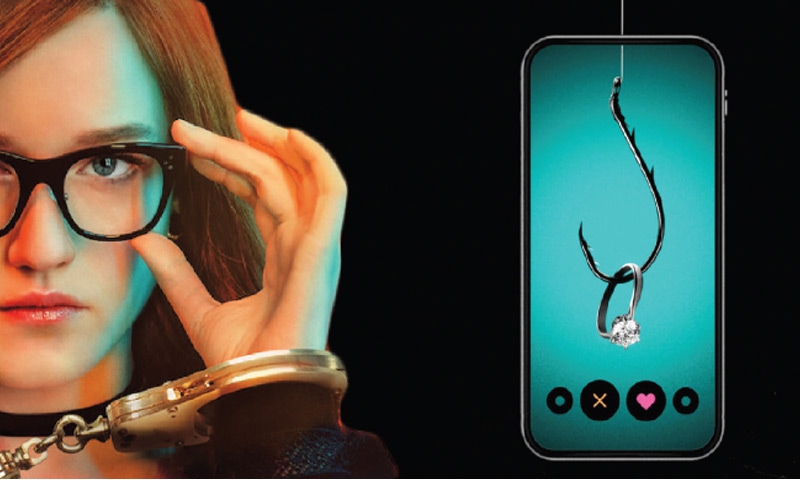
I nventing Anna is a fictionalised version of the case of Anna Sorokin/Delvey, who fooled the New York social set into believing she was a German heiress. The original story was reported on for a viral article in The Cut back in 2018. Tinder Swindler recounts the true story of Simon Leviev (Shimon Hayut), who conned $10 million from women on Tinder pretending to be the son of an Israeli diamond trader.
This prevalence of the scam narratives begs the question: why do fraudsters fascinate us? The answers lies in the way we see ourselves and how we view the gullibility of others who have fallen prey to these con artists.
Watching a scam artist at work
We tend to think of ourselves as good decision makers. Human brains have evolved a “cheating detecting module”, allowing us to establish cooperation with strangers. Bottom line: we assume we would see the red flags. Watching a scam artist at work fills us with a mix of surprise at their audacity — and glee and relief that it didn’t happen to us.
But it’s the methods scam artists use to con people that are the same reason we are so fascinated by them. The truth is, con artists make systematic use of every rule in a veritable playbook of exploiting our human psychological foibles.
Decision making is cheap and cheerful
According to psychologists, we make around 35,000 decisions a day, and each comes with an unmanageable complexity in countless options and their possible consequences.
Given our limited brainpower, we automatically resort to mental shortcuts known as heuristics to make good (rather than perfect) decisions. Think of these as the software of our minds, standard operating procedures we use for all of our mundane and repetitive decisions. Examples of heuristics we use in everyday life would be the decision of how to get to work, or what to have for breakfast, or how we evaluate people when we first meet them.
Despite their advantages in everyday decision making, heuristics sometimes get it horribly wrong. Con artists exploit these systematically by understanding how people make good and not-great decisions. Psychologist Robert Cialdini, author of Influence, the definitive manual of persuasion tricks, explains the most common ones tricksters exploit.
One is the social proof heuristic — the con artist’s success and connections are meant to demonstrate that others believe them and their lies too. Here the shortcut to decision-making is that we tend to rely on the decisions others make.
People discount the improbable
One reason we fail to detect con artists is that they are, thankfully, relatively rare, which is what makes characters like Anna Delvey and Elizabeth Holmes so fascinating. Psychologists have found that people underrate the probability of rare events. Our brains evolved economically, equipped to deal with the most important and common threats — this leaves us vulnerable to rare decision problems.
People think good things come in three (or four or five)
When we meet people who present as super-wealthy or super-attractive, we tend to use shortcuts to attribute a whole series of positive characteristics to them. We form impressions of one another exceptionally rapidly, perhaps as quickly as under one second after exposure to another individual.
Con artists exploit the fact that seeing only one observable “good” quality in a person is enough for a favourable general impression. We call this the halo effect, it is a confirmation bias first described by American psychologist Edward Thorndike in 1920. The halo effect explains how, when we ascribe one positive attribute to someone, we inadvertently add other positive traits to our overall impression of them. So, if someone is rich, we tend to believe they might also be honest, hardworking and fair.
Fame means power
Con artists often carefully curate an illusion of being famous and well connected — which Anna Delvey did with flair. We are also programmed to respond to the social status of others.
It tickles our ego if a person of perceived status engages with us — the desire for a positive self-image stops us from questioning their real status or intent.
It can’t happen to me
Unfortunately, there is a final bias that makes us lower our guard: overconfidence. We like to think that we are not so gullible. The average person thinks they are above average when it comes to resisting persuasion and decision-making.
The one saving grace is that our interest in con artists shows our ability to learn from others’ experiences. Here the internet and Netflix are playing their part to warn us. Con artists, we are on to you.
Meg Elkins is a Senior Lecturer with the School of Economics, Finance and Marketing and Behavioural Business Lab Member, RMIT University. Robert Hoffman is a Professor of Economics and Chair of Behavioural Business Lab, RMIT University
Republished from The Conversation
Published in Dawn, ICON, March 27th, 2022