India, China discuss steps to end border impasse early


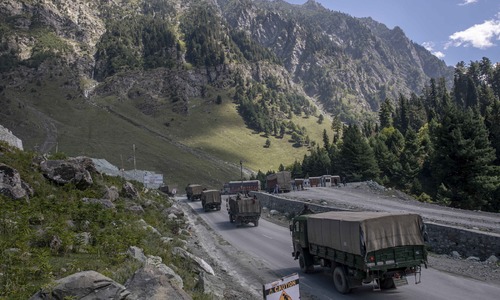
Chinese Foreign Minister Wang Yi met with his Indian counterpart and the national security adviser on Friday to expedite the disengagement of thousands of Indian and Chinese forces involved in a tense faceoff and occasional clashes along their disputed border, an Indian official said.
A fierce brawl in June 2020 exploded into hand-to-hand combat with clubs, stones and fists that left 20 Indian soldiers dead. China said it lost four soldiers in the clash.
“I would describe the current situation as a work in progress obviously at a slower pace than desirable,” India's External Affairs Minister Subrahmanyam Jaishankar told reporters. He was referring to 15 rounds of talks between military commanders as well as diplomatic contacts between the countries to end the impasse.
Friday's talks with Wang focused on expediting the disengagement of troops in friction areas and the possibility of de-escalating the situation, he said.
“The frictions and tensions that arise from China's deployment cant be reconciled with the normal relationship between the two neighbours.”
Jaishankar said that Wang spoke about China's desire for normalcy in ties with India. But he told him that would require restoration of peace and tranquility on the border, suggesting total disengagement of forces.
Since February last year, both India and China have withdrawn troops from some sites on the northern and southern banks of the Pangong Tso Lake, Gogra and Galwan Valley, but they continue to maintain extra personnel as part of their deployment.
The Indian side treated Wang's first visit to New Delhi in more than two years as a low-key event, apparently unsure of the outcome.
Jaishankar said the visit was not announced in advance at Beijing's suggestion.
The two foreign ministers also discussed the war in Ukraine.
Both India and China have friendly ties with Russia and have rejected Western calls to condemn Moscow's invasion.
Read: India urged to condemn Russia if it wants to be taken seriously
Jaishankar said they “agreed on the importance of an immediate cease-fire as well as return to diplomacy and dialogue.”
Wang did not speak to the media after the meeting.
He is expected to leave for Nepal today, after visiting Afghanistan on Thursday for talks with the new Taliban rulers.
A day before Wang's trip to Delhi, India criticised his comments on occupied Kashmir during a speech he gave at a meeting of the Organisation of Islamic Cooperation (OIC) in Pakistan earlier this week.
Read: 'We have failed Kashmiris and Palestinians,' PM Imran tells OIC moot
Indian media reports quoted Wang as saying that China shares the same hope as the OIC on the Kashmir issue.
The OIC is supportive of Pakistan's stand on occupied Kashmir, which says India has been violating human rights in the valley and seeks a plebiscite to determine the future of the region.
India's External Affairs Ministry spokesman Arindam Bagchi said in a statement that matters related to occupied Kashmir are entirely the internal affairs of India and that other countries, including China, have to right to comment.