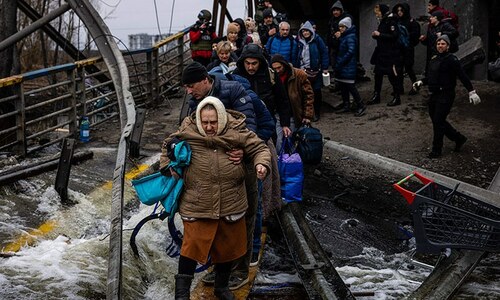
Ukrainians flee encircled cities as refugees top two million

KYIV: Desperate civilians fled besieged cities in Ukraine on Tuesday as fresh fighting raged between Ukrainian and Russian forces.
On the 13th day of the conflict the number of refugees flooding across Ukraine’s borders to escape towns devastated by shelling and air strikes passed two million, the UN said.
Buses streamed out through an evacuation corridor from the northeastern city of Sumy — where 21 people were killed in air strikes overnight — while civilians on foot took an unofficial escape route out of the bombarded Kyiv suburb of Irpin.
But Ukraine accused Russia of attacking a corridor from the beleaguered southern port city of Mariupol, where aid workers said tens of thousands were living in “apocalyptic” conditions.
Kyiv has branded the corridors a publicity stunt as many of the exit routes lead into Russia or its ally Belarus. Both sides accuse each other of ceasefire violations.
US President Joe Biden said Ukraine would “never be a victory” for Putin, as he announced the measures targeting the energy sector that props up the Russian economy and its war effort.
The Pentagon estimated that between 2,000 and 4,000 Russian soldiers had been killed so far. Russia said on March 2 that 498 Russian troops had been killed in Ukraine.
Russian troops are slowly encroaching on Kyiv despite intense efforts by outgunned Ukrainian forces, and moving faster through the east and north of the country.
Despite the sound of nearby shelling in Irpin, seen as a critical point for the advance on the capital, civilians fled in icy wind and thick snowfall, reporters saw.
People waited in a long line to cross over the Irpin river on makeshift walkways of planks and mangled metal, after the Ukrainians blew up the bridge leading into the capital to hamper any Russian advance.
“I didn’t want to leave, but there’s nobody left in the homes around us, no water, no gas and no electricity,” Larissa Prokopets, 43, said.
She said she was leaving after several days spent “hiding in the basement” of her home, which kept “shaking” due to bombardment nearby.
Russia had refused calls for a humanitarian corridor in Irpin and the nearby suburbs of Bucha and Gostomel “although we had everything ready for this”, Ukrainian interior ministry official Anton Gerashchenko said.
Evacuations had however begun in Sumy, near the Russian border and 350km east of Kyiv, where Russia had formally declared a humanitarian corridor, officials said.
Dozens of buses had already left in the direction of Lokhvytsia, to the southwest, with the corridor designed to evacuate civilians, including Chinese, Indians and other foreigners, officials said.
Ukraine’s defence ministry also accused Russia on Tuesday of violating a ceasefire to ease a days-long blockade of Mariupol, describing it as “genocide”.
Ukrainian President Volodymyr Zelensky denounced what he called un-kept promises by the West to protect his country, and renewed calls for a no-fly zone that leaders have so far dismissed.
“It’s been 13 days we’ve been hearing promises, 13 days we’ve been told we’ll be helped in the air, that there will be planes,” Zelensky said on a video broadcast on Telegram.
Global outrage mounted over the invasion and the plight of civilians caught up in the bloodshed.
The International Committee of the Red Cross said Mariupol residents faced “atrocious” conditions and were running out of food, water and medical supplies.
“The bottom line today is that this situation is really apocalyptic for people,” ICRC head of media Ewan Watson said in Geneva.
At least 474 civilians have been killed since the start of Russia’s assault on its ex-Soviet neighbour, according to the UN, although it believes the real figures to be “considerably higher”. The onslaught has created a huge refugee crisis for European countries that have taken in Ukrainians fleeing the conflict, particularly Poland. “It doesn’t stop,” Filippo Grandi, the UN High Commissioner for Refugees, said as he announced that two million people had fled.
Published in Dawn, March 9th, 2022